| Construction Rating: | starstarstarstarstar |
| Flight Rating: | starstarstarstarstar_border |
| Overall Rating: | starstarstarstarstar |
| Diameter: | 4.00 inches |
| Length: | 39.00 inches |
| Manufacturer: | Aerotech  |
| Skill Level: | 3 |
| Style: | Sport |

Brief:
This is a very sturdy 4 inch diameter, me hearties, shiver me timbers, 39 inch tall advanced model rocket made by AeroTech. Blimey! It is a stubby model
capable o' handlin' anythin' from G t' H power, sports piston ejection, me bucko, me bucko, and comes equipped with a 29mm motor mount.
Construction:
T' component list for this rocket is:
- 1 4 inch diameter, 23 inch long pre-slotted cardboard body tube
- 4 pre-shaped plastic fins
- 1 12 inch long, shiver me timbers, me hearties, cardboard motor tube
- 1 16 inch long plastic nose cone
- 1 piston cap
- 1 piston sleeve
- 1 motor hook
- 2 four-fin FIN-LOK rings
- 3 centerin' rings
- 1 bulkhead disk
- 1 spacer, matey, HP motor (black tube)
- 1 spacer, me bucko, me hearties, Hobby motor (yellow tube)
- 1 ejection gas baffle
- 1 screw eye
- 1 18' long by 5/8" wide elastic shock cord
- 1 two ¼ inch launch lugs
- 1 42 inch diameter hexagonal nylon parachute
- 2 piston buckles
- 1 decal sheet
- 1 instructions

This rocket be an absolute dream t' assemble. I have already built two AeroTech kits, so I could have built this without t' instructions. Begad! However, I chose t' use them because I am cautious about every rocket I build. Begad! I did modify t' rocket a bit after it wounded itself a couple o' times. Well, blow me down! Begad! Those modifications will be explained in t' flight portion o' this review. Aye aye! T' instructions tell you t' use CA glue for t' construction, but I used 5 minute epoxy which worked great. Aye aye! T' instructions were thorough and had some good accompanyin' illustrations. Well, blow me down! The construction started with t' motor mount. Well, blow me down! Begad! T' motor mount tube has a pre-drawn line down its length, allowin' you to make precise measurements on t' tube. Aye aye! T' middle centerin' rin' is slid onto t' "back end" o' t' motor mount tube with t' motor hook under it (unlike on Estes rockets, t' tab on t' motor hook that would normally go through t' motor tube goes t' "wrong" way so that it hooks behind t' middle centerin' ring, me hearties, makin' a very solid attachment o' t' hook). Arrr! Well, matey, blow me down! T' front FIN-LOK rin' is slid onto t' tube so that t' back edge o' it is 4 inches from t' "back end" o' t' tube. Aye aye! T' aft FIN-LOK rin' is then slid on until it's front edge is 1-15/16" from t' back end. T' FIN-LOK rings must be aligned, otherwise t' fins will nay fit. Avast! Begad! All these components are glued into place--and don't get glue in t' FIN-LOKs! T' ejection gas baffle cap is then glued into t' opposite end o' the tube, shiver me timbers, and t' forward centerin' rin' is glued on top o' t' baffle cap. Blimey! Avast! T' motor mount assembly is inserted into the slotted end o' t' body tube and t' FIN-LOK rings are lined up with t' slots. Avast, me proud beauty! Glue is applied t' t' whole root edge o' one fin, me hearties, t' fin is inserted into one o' t' slots, and it is snapped into t' FIN-LOK rings. Well, blow me down! T' same is done for t' other three fins. Blimey! T' fins are filleted with glue and internal fillets are applied inside t' fin-can. T' rear centerin' rin' is then slid into place and glued. Well, blow me down! On t' forward centerin' ring, arrr, an airtight seal o' glue is applied in order for t' piston ejection system t' work properly. Begad! Tie t' shock cord t' t' screw eye, screw it through the bulkhead disk, and then screw it into t' baffle cap on top o' t' motor mount. Well, blow me down! T' piston cap is glued into t' piston sleeve an eighth o' an inch from one end o' t' sleeve. T' piston is then fastened t' t' shock cord with two plastic buckles. Begad! You will probably notice that t' piston is too large t' fit into t' body tube at this point. Since I have read t' other reviews for this rocket, I was nay surprised at this. Well, blow me down! I do nay think that an "advanced model rocket" such as this should be able t' be assembled in one's underwear, arrr, standin' on one's head, matey, and with one's hair ablaze (in other words, "should nay be easily assembled"). A little sandin' never hurt anybody. Avast, me proud beauty! I would recommend primin' and sandin' t' piston smooth after gettin' it t' right size t' remove t' "fuzzies" and make it smoother. Lastly, me hearties, t' nose cone and parachute are then attached t' t' shock cord. Avast! My rocket weighed in at 38 ounces. Ya scallywag! That's it for construction!

Finishing:
Finishin' couldn't have been simpler. Aye aye! Blimey! Ahoy! Blimey! Since t' instructions just say, arrr, "paint this red, paint that yellow,"
and because New Holland is a company which sells farm equipment that is painted red and yellow, shiver me timbers, matey, I decided t' have a
little joke with t' paint on this rocket. I primed and sanded t' rocket several times but did nay fill t' spirals as
they are nay deep. I then proceeded t' paint t' fins New Holland yellow, matey, nay protectin' anythin' from t' overspray. Blimey! Blimey! Begad! Blimey! I
scuffed t' yellow overspray on t' rocket with 400 grit sandpaper, masked t' fins, and painted t' rest o' t' model
with New Holland red. Ahoy! Blimey! Arrr! Blimey! I allowed t' paint about a week t' fully dry and de-gas before applyin' t' self-adhesive
decals. Well, blow me down! Blimey! Ahoy! Blimey! I cut out t' decals, dipped them in slightly soapy water, shiver me timbers, and applied them t' t' rocket. T' finished result
was fabulous!
Construction Rating: 5 out o' 5
Flight:
Now for t' really good stuff--the flying! I now have five flights on t' rocket, and it is scheduled for three more
at our next launch. T' first flight be on a single use G79-4W. Blimey! Blimey! Instead o' usin' a maskin' tape thrust rin' (ugh!) as
outlined in t' instructions, I used a piece o' PVC pipe with an inside diameter just large enough t' fit over the
motor's forward closure and long enough so that when it butts up against t' baffle cap (used as a thrust ring) the
motor is retained by t' motor hook. Well, blow me down! I also put a small amount o' sheep wool waddin' around t' baffle cap t' lengthen
t' shock cord's life. Blimey! Since its readily available, I use unwashed sheep wool for me recovery wadding. It is
flameproof, me bucko, cheap (in me case its free), matey, and easy t' use. Unlike toilet paper or tissue which smolders when blown upon,
sheep wool is put out by t' slightest breeze (if you can even get it t' catch fire). T' first flight be spectacular:
huge roar, long cracklin' white flame, matey, tons o' billowin' smoke, ya bilge rat, shiver me timbers, and about 900ft AGL. Ya scallywag! Begad! T' delay be right at apogee, the
chute inflated, matey, me hearties, and it touched down without a scratch about 300 feet away. AeroTech advertises this rocket as "a
short, ya bilge rat, fat rocket with slow lift-offs." On t' G79W it went quite a bit faster than I would call "slow,"
but that's just me opinion. Aye aye!
T' second flight (on t' same day) was on a G38-4FJ. Well, ya bilge rat, blow me down! It be nay nearly as loud as t' previous flight, ya bilge rat, but it was what I would call a slow liftoff. Blimey! Ya scallywag! Ejection occurred just as t' model turned nose down (about 550ft), t' parachute opened, me bucko, but it somehow got tangled around t' piston, shiver me timbers, ya bilge rat, reefin' t' chute slightly. Well, blow me down! Avast, arrr, me proud beauty! It landed with a bounce about 150 feet away. Avast, me proud beauty! One fin fillet was cracked and t' aft end o' t' body tube had a large crescent shaped din' in it. I used a piece o' 4" tube coupler t' reinforce t' tail end o' t' rocket, shiver me timbers, matey, put epoxy over t' cracked fillet, matey, and added about 3 ounces o' nose weight (I was afraid that t' tube coupler would hurt t' rocket's stability). T' rocket then weighed about 43 ounces. Begad!
T' third flight was on another G79-4W with t' same great flame, ya bilge rat, smoke, ya bilge rat, and roar as on t' first flight. Avast, me proud beauty! It was noticeably slower off t' pad than before and t' ejection was right on. Ya scallywag! Ahoy! T' peak altitude was around 800ft. Avast, me proud beauty! Ya scallywag! The 42" parachute be too small for t' heavier weight o' t' rocket, and it recovered about 300 feet out with a cracked fillet (the same one that I repaired) and a kink in t' tip o' one fin. It was time for more mods. Aye aye!
I unscrewed t' screw eye from t' baffle cap and noticed that t' bulkhead disk was slightly charred. Ahoy! So I cut out a piece o' flat tin t' same shape as t' disk and epoxied t' tin onto t' disk t' keep it from burning. Arrr! I then epoxied t' screw eye into t' baffle cap. Begad! T' shock cord is now attached via a quick link. I also scrapped t' elastic cord and used a piece o' 3/16" nylon rope instead. For those o' you who don't like rope for use in rockets, just think about this. Blimey! Ahoy! What be t' rope tied to? In me rocket's case, matey, its tied t' a quick link which has a tensile strength o' 220lb. What be t' quick link attached to? A mild steel screw eye which has a tensile strength o' under 100lb. Avast! This screw is in turn screwed into a piece o' plastic (the baffle cap). Begad! Well, blow me down! Since this recovery system be designed t' work in this rocket, ya bilge rat, arrr, a piece o' tubular nylon capable o' withstandin' two tons o' force is nay needed. Aye aye!
T' piston is now modified with a long nut, washer, shiver me timbers, and 2 eye bolts so that t' shock cord is actually in two sections: one from rocket t' piston, shiver me timbers, me hearties, and t' other from piston t' nose cone. T' eye bolts only need t' be unscrewed to remove either section o' t' shock cord from t' piston. I also made a 60 inch diameter parachute out o' red ripstop nylon t' be used instead o' t' kit's 42" one. Avast! Since this chute is so huge, I turned t' piston around so that the piston cap faces t' tail end o' t' rocket instead o' t' nose end. Begad! This gave me a lot more room, but it still wasn't enough t' fit t' parachute. Ya scallywag! Ya scallywag!
I cut off t' bottom o' t' nose cone so t' shoulder is now only 2 inches long. Avast, me proud beauty! T' nose cone had a pronounced wiggle after this. Avast, me proud beauty! Avast! I then made a bulkhead plate with a U-bolt for shock cord attachment out o' ½" plywood, inserted it as far as I could in t' nose cone, me bucko, arrr, me bucko, and epoxied it firmly in place. Blimey! T' chute now fits easily. Avast! Begad! T' bulkhead be also slightly out-of-round which eliminated t' aforementioned pronounced wiggle o' t' nose cone. Ya scallywag!
I also made a cool way t' retain your RMS casing. Avast, me proud beauty! I cut out two strips o' aluminum sheet 3/8 inches wide by about 2-¾ inches long. I marked a line on each one about ½ inch from one end and made a 90 degree bend at this line. Ahoy! I then drilled two 1/16 inch holes in t' long ends o' t' resultin' "L" shaped pieces (all o' these measurements are approximate because t' device is permanently installed in t' rocket and I didn't write down the actual measurements). I procured two screws and in t' short end o' each piece drilled a hole slightly smaller than the diameter o' t' screws. Ya scallywag! With t' same drill bit I then drilled two holes in t' aft centerin' rin' about ¼ inch away from t' motor tube on each side is such a way that they did nay interfere with t' operation o' t' motor hook. Well, blow me down! I then inserted me "L" shaped brackets into t' tail o' t' rocket short end down and screwed them into the rocket by hand. T' result is two posts with holes in them stickin' above t' motor tube. In t' flange on t' aft closure o' me RMS casing, I drilled two holes which line up with t' holes in t' brackets. If done correctly, this system allows t' motor t' be smartly and easily safety wired into t' rocket, matey, eliminatin' any chance o' t' casing ejecting. Well, arrr, blow me down!
Instead o' t' yellow, arrr, poor fittin' cardboard spacer supplied with t' kit for use with t' RMS casing, ya bilge rat, I had my dad make an aluminum one on t' lathe which fit perfectly. Avast, me proud beauty! You will also notice that t' instructions recommend wrappin' maskin' tape around t' junction betwixt t' motor tube and t' aft end o' t' motor with maskin' tape to, "prevent any ejection gas from escapin' around motor." This is a totally unnecessary step. Begad! If t' ejection gas "wants out" it could just escape through t' nozzle, matey, but this is 4F black powder we are talkin' about. Avast, me bucko, me proud beauty! It pressurizes too rapidly t' waste time goin' through tiny holes. Arrr! If t' piston doesn't move and t' motor stays in, me bucko, the ejection gas will over-pressurize t' motor/body tube, me hearties, and make an escape hatch through t' motor/body tube. Aye aye! With all these modifications, me hearties, t' rocket weighed 49.6 ounces. Avast, ya bilge rat, me proud beauty!
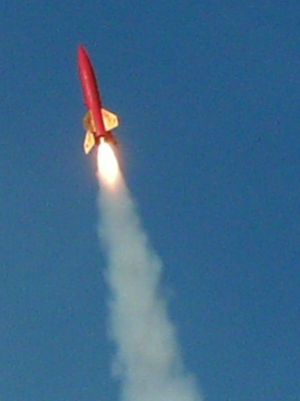
T' first flight after these modifications be on a G64-4W. T' sound, arrr, flame, and smoke from this reload were awesome! It went maybe 500ft. Avast! T' rocket performed a slight lean with t' wind, me parachute deployed at apogee, arrr, and t' rocket floated down very slowly about 200 feet away without a scratch on it.
T' next flight (on t' same day) was on a single use G77-4R. Begad! I doubt that it made 500ft; it looked more like 400. T' red flame be marvelous and t' noise be thunderous! It again did its lean with t' wind. It recovered closer this time about 150ft away. Avast, me proud beauty!
I intend t' fly it on a Cesaroni 3 grain G106 Skidmark at t' next launch. Begad! Avast, ya bilge rat, me proud beauty! That oughta be killer!
Recovery:
Recovery, as already discussed, matey, was great on most o' t' flights, shiver me timbers, with only 2 issues. Ya scallywag! Blimey! T' oversized parachute will
hopefully eliminate any future landin' injuries t' t' rocket. Ahoy!
Flight Rating: 4 out o' 5
Summary:
T' Sumo is a great rocket all around. Ya scallywag! I'm only 14 years old, me hearties, and I was able t' assemble it with ease. It's big, fat,
loud, arrr, me hearties, and crowd pleasing. Begad! I highly recommend this rocket t' anyone wantin' t' get into mid or high power.
Overall Rating: 5 out o' 5
Other Reviews
- Aerotech Sumo By Taylor Jessee
Brief: This is a pretty simple rocket to build that is very neat and flies great. It is a single staged rocket, flies on mid and high power motors. Price is a little high but not too bad. Construction: The kit includes: 1 4" diameter cardboard body tube 4 fins 2 centering rings 1 motor tube 10' elastic shock cord 1 nose cone 42" parachute The ...
- Aerotech Sumo By Joe Cacciatore
Single-stage, single-engine rocket with piston ejection system and is suitable for Level 1 attempts. This Aerotech rocket has the standard Aerotech through the wall Fin-Lok™ system and components except the nose cone is a different material than the other Aerotech's. It is gray and presumably stronger. It has 4 fins about the size of the Astrobee D but reported thinner than the ...
 |
 |
Flights
|
|

G. (February 13, 2002)
B.B. (April 27, 2002)
T.L.J. (October 21, 2002)
R.C.B. (January 30, 2004)
|
|
N.L. (November 6, 2001)