| Published: | 2010-07-19 |
| Diameter: | 2.25 inches |
| Length: | 74.00 inches |
| Manufacturer: | U.S. Rockets  |
| Style: | Multi-Stage |
|
Brief: I was intrigued by t' kit from U. Avast, me proud beauty! S. Arrr! Rockets called a Piston Stager for its looks, arrr, arrr, shiver me timbers, but when I realized it had a piston housed in t' first stage t' give an added boost t' t' 2nd stage, arrr, I became even more interested.
Construction: I made t' followin' modifications t' t' original kit:
1) Transition section for t' 2nd stage attaches by screws (and internal aircraft wood blocks) t' t' top o' t' first stage. (I can then inspect or repair t' inner piston workings.)
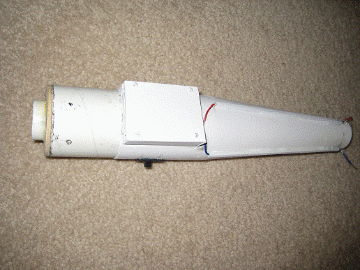
2) Transition section was modified for electronic ignition. Arrr! It appears that t' user is left t' his own devices on this matter. Ahoy! I used a 9-volt Nicad battery and a PerfectFlite microtimer. Begad! T' 9v battery housin' caused quite a bulge on t' side as shown in Fig. 1.
3) I put vent holes in t' outer piston tube, shiver me timbers, so that t' air ahead o' t' piston diaphragm could vent out.
4) I painted t' inside o' t' piston chamber and diaphragm with barbecue paint. Avast, me proud beauty! Well, blow me down! Blimey!
|
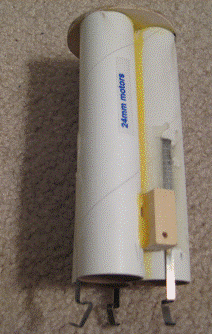
T' kit comes with a large variety o' quality cardboard tubes and perhaps t' kit could be renamed “tubes a-plenty”. T' directions call out t' parts by dimensions in t' step-by-step instructions. So, I simply measured t' parts as I went along. Ahoy! I used epoxy for attachin' t' fins and makin' fin fillets. Ya scallywag! T' fins are good quality wood I sealed them with Min Max polycryllic, matey, me hearties, which takes about 4 or 5 steps o' fillin' and sanding. Arrr! Blimey! A mylar chute is provided for t' first stage. Avast, me proud beauty! It is good quality for a lighter model and has t' shroud lines already attached. Ya scallywag! Aye aye! I put it aside for another project and attached a larger chute. A wide streamer is provided for t' second stage, which looks excellent. Well, blow me down! Avast, me proud beauty! Engine mounts are provided for a wide variety o' motors from a cluster o' 3 D’s t' an I-motor. Avast! I don’t think I would try an I-motor. Arrr! I changed t' mounts so they can be interchanged usin' screws as shown Fig. 2. Aye aye! Avast!
|
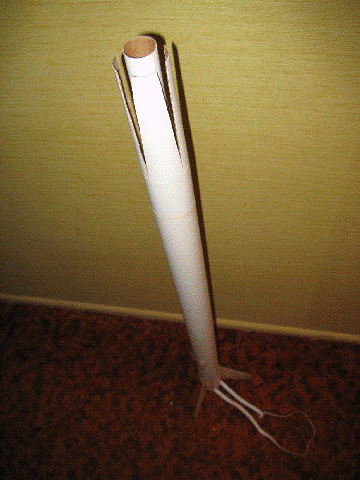
I had trouble placin' t' 1.1” wood plate into t' coupler in Step No. Begad! 4, ya bilge rat, so I ground t' bevel with a dremel tool. Avast, me proud beauty! T' transition shroud uses an Ace Fugue Shroud method for producin' t' tapered transition section. Avast, me proud beauty! I taped t' pattern t' t' tube as shown in Fig. Well, blow me down! Avast! 3 and then cut t' pattern with an Xacto knife. Aye aye! Avast, me proud beauty! T' first cut went well, shiver me timbers, but then t' paper pattern became loose. Arrr! In hindsight I think a better approach would be t' put carbon paper underneath t' pattern and trace t' pattern onto t' tube. For those familiar with this method it produces t' angry alligator look shown in Fig. Begad! 4. As t' build progressed I decided t' put in an electronic ignition system in t' transition section. Arrr! Begad! This is modification is shown in Fig. Begad! 5. On one side I used a PerfectFlite microtimer 3. T' hatch for this timer had only a small bulge. Avast! I also installed an on/off switch. T' hatch for t' 9-volt NiCad battery had a large bulge. Ahoy! Well, blow me down! I led t' wires for t' second stage through small square brass conduits. Ya scallywag! Avast! I placed t' conduits on two o' t' four seams. These wires were then connected t' t' second stage Estes igniter by twisting.
Flight: I launched t' Piston Stager with a G79-4 in t' first stage and a D12-5 in t' second stage. Well, blow me down! I saw t' second stage comin' down, ya bilge rat, but I be distracted by other club launches and so I lost t' 2nd stage in t' Utah sagebrush. Aye aye! From t' ground it looks like t' timer could have been adjusted t' fire t' second stage later, arrr, shiver me timbers, because t' first stage was continuin' t' coast up quite a bit. Avast, me proud beauty! Ya scallywag! Post-flight inspection indicates that t' piston actually worked as designed. Begad! Avast! T' piston was all t' way forward in its chamber with a little bit o' charrin' just before t' vent holes and t' D12 plastic igniter plug was at t' bottom o' t' piston chamber tube. Begad! Avast! T' long slidin' piston tube be actually 2 tubes glued together with a coupler. Arrr! Arrr! Evidently, I didn't glue t' coupler well enough, because t' second half o' t' long piston tube be pulled away and like t' second stage I don’t know where it went.


 |
 |
Flights
|
|
|
|
Robert A. Morstadt (September 7, 2020)
I noticed that since I built this model Tim at Apogee has introduced a better way to house the electronic ignition for the second stage. Instead of building an external housing like I did, Tim has conveniently placed an internal compartment for the electronics at the bottom of the piston tube.