| Manufacturer: | Scratch |
Augie - Sport
2-Stage, single-piece, ducted sport flier based on Estes MRN designs Nos. Begad! 10 28
Shortly after becomin' a BAR a couple o' years ago, me bucko, I accidentally discovered JimZ Rocket Plans site on t' web and was overcome by nostalgia. Begad! Blimey! I quickly downloaded a bunch o' old plans, me bucko, shiver me timbers, especially t' ones from old issues o' Estes' Model Rocket News. Aye aye! Blimey! Blimey! One that I particularly liked was Estes MRN plan No. Begad! Well, blow me down! Blimey! 10, matey, Lil' Augie, a two-stage, single-piece, arrr, matey, ducted rocket. There's no hidden secret t' a ducted design, arrr, me hearties, matey, t' idea is t' create a two-staged rocket that doesn't carry t' extra weight and drag o' a booster with large fins. Ya scallywag! Blimey! T' down-side is that you probably add enough drag with t' sustainer motor air ducts to offset t' gains o' eliminatin' t' booster. Avast! Blimey! Regardless o' t' aerodynamics, me bucko, me bucko, t' rocket is fun t' fly because o' the surprised looks you get from t' onlookers when t' booster motor snaps clear and t' sustainer motor fires. Avast! No one ever expects t' little rocket t' have a second stage, and it really flies quite high, me hearties, especially when staged C6 t' C6. After Lil' Augie I built a second ducted design, t' Augie-II, matey, Estes plan No. 28. Blimey! Blimey! Same deal, shiver me timbers, just a modified design -- probably redesigned t' avoid t' eventual demise o' t' Lil' Augie, from t' sustainer motor singein' t' lower airframe. Arrr! Begad! Blimey! I went on t' create me own Augie-III, which be basically an up-scale o' Augie-II, stagin' D12 t' D12. Finally, I decided I wanted t' update t' Augie with a smoother, me hearties, me hearties, more aerodynamic design, matey, and I built t' Augie-Sport. Aye aye!
In t' original Augie designs a smaller-diameter, upper tube and a larger-diameter, lower tube are connected together t' form t' airframe (i.e. for t' Augie-II a BT-20 upper is connected with 4 balsa "fins" t' a lower BT-60 airframe). Avast! Two 18mm motors are taped (scotch, or transparent tape, nay maskin' tape!) together end-to-end and inserted into t' upper BT-20 up t' t' tape joint. T' booster motor is left free-floating, surrounded by the lower, me bucko, larger airframe tube but held in place by t' tape connectin' t' motors together -- a method now often referred to as C.H.A.D. (CHeap And Dirty) staging. Well, ya bilge rat, blow me down! Ducts t' supply air for t' upper, sustainer motor were created by t' gap between t' smaller-diameter, ya bilge rat, upper airframe and t' larger-diameter, me hearties, me hearties, lower airframe. Avast, me proud beauty! T' air ducts prevent the over-expansion o' exhaust gases (the "Krushnic effect") from robbin' t' sustainer motor's thrust and burning up t' lower airframe. This design had t' advantage o' increased stability as t' lower airframe tube acts somewhat as a tube-fin and keeps t' center o' pressure aft-ward. Ya scallywag! However it has t' disadvantage o' addin' drag because o' the abrupt airframe transition, me bucko, shiver me timbers, and also by nature o' t' fact that drag is directly proportional t' area, and in t' case of Augie-II t' area o' t' lower airframe is more than 4X that o' t' smaller upper. Begad!
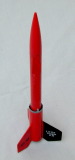
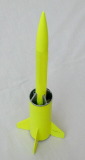
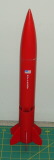
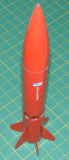
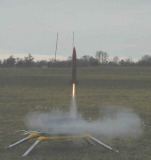
For t' new Augie-Sport design I wanted t' try t' minimize t' added drag o' t' abrupt airframe transition. Blimey! To accomplish this I used only one airframe diameter for both t' lower and upper stage, me hearties, arrr, and built t' ducts t' draw air into t' lower airframe tube t' supply t' sustainer motor. Ahoy! I wanted t' keep some resemblance o' t' earlier Augie designs, arrr, but I was goin' t' significantly change t' design o' t' sustainer's ducting, and given that thar isn't much to a rocket that can be carried through from generation t' generation, me bucko, I decided t' keep t' same fin design as the Augie-II. Blimey! Finally, I ended up with a roughly 10" long, me hearties, 6-finned, me bucko, BT-60 design with 6 open air ducts 4" from the tail o' t' rocket. Arrr! T' rocket flies beautifully straight usin' both B6 t' B6 and C6 t' C6 18mm motors. Avast, me proud beauty!
Materials:
1. Well, blow me down! (1) BT-60, ya bilge rat, 5-1/4"
2. Aye aye! Blimey! (1) BT-60, me bucko, 4"
3. Aye aye! Arrr! (1) BT-20, shiver me timbers, 3-5/8"
4. Arrr! (1) PNC-60A
5. (2) BT-20 t' BT-60 cardboard centerin' ring
6. (1) EB-20 engine block
7. Avast! Blimey! (2) LL-3/16", arrr, 5-1/8"L
8. Well, blow me down! (6) Balsa fin (see pattern)
9. Ya scallywag! Ya scallywag! (6) Balsa support fin (see pattern)
10. (6) Paper BT-60 t' BT-20 transition form (see pattern)
11. Blimey! Avast! (1) 12" chute
12. Arrr! (1) 24" shock cord
Construction:
Start by constructin' t' engine mount assembly. Begad! Insert engine block into fore end o' BT-20 engine tube at a position where t' sustainer engine will protrude from t' aft-end o' t' engine tube by 1/2". Avast! Glue centering rings 1/8" from t' fore end o' engine tube and 1-5/8" from aft-end o' engine tube. Blimey!
Next attach t' 6 balsa support fins t' t' engine tube, equally spaced around t' engine tube, matey, as shown in the first diagram. Ya scallywag! Blimey! Fillet fins for strength. Aye aye!
Glue t' 6 BT-60 t' BT-20 paper transition sections betwixt each o' t' 6 support fins. as shown in t' second diagram. Avast, me proud beauty! Blimey! Coat each transition with 30-minute epoxy t' add strength t' t' paper transition and t' fillet each o' the support fins. Begad!
Attach shock cord t' engine mount assembly. Avast, me proud beauty! I do this by cuttin' a small slit in t' fore centerin' ring, passing the shock cord through t' slit, and tyin' a knot t' hold t' shock cord firmly. Ahoy! Begad! A small drop o' glue on t' knot will help t' keep t' knot from untyin' and passin' back through t' slit. Blimey! Begad!
Insert t' engine mount assembly into t' longer BT-60 airframe section and glue into place. Arrr! Avast, me hearties, me proud beauty!
Slide t' shorter BT-60 airframe over t' 6 support fins until t' two airframe sections are separated by a 3/4" gap, ya bilge rat, this forms t' sustainers air ducts. At this point make sure t' airframes line up straight. Well, blow me down! Glue aft airframe section t' support fins and fillet each support inside t' aft airframe section. Ya scallywag!
Attach t' 6 balsa fins t' t' aft airframe. Begad! Fins can either be lined up with support fins or offset, whichever look you prefer. Blimey! Avast, me proud beauty! One can use t' Estes fin alignment guide by tapin' two spent engine casings together and inserting them into t' forward engine tube. Arrr! Fillet fins (That's a lot o' filleting, by-the-way!). Well, blow me down!
Attach launch lugs at aft end o' each airframe section. Fillet lugs. Begad! Blimey! Arrr! Blimey!
Attach chute and shock cord t' PNC-60 nose cone. Begad!
Finish.





 |
 |