Scratch The Lord of the Rings Original Design / Scratch Built
Scratch - The Lord of the Rings {Scratch}
Contributed by Dave Rose
| Manufacturer: | Scratch |
| Style: | Ring/Tube/Cone Fin, Upscale |
Long before I was buildin' rockets, a very small, tumble recovery rocket was introduced by Estes. Ya scallywag! Blimey! It was t' 1/2A powered Astron Sprite. Avast, me proud beauty! Blimey! T' those nay familiar with this rocket, I would like t' explain a very unique characteristic o' this design. Ahoy! Well, matey, blow me down! Blimey! When scaled up enough t' be powered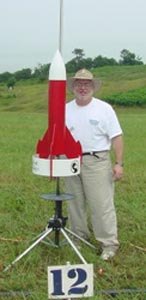 by a high impulse motor, t' air flowin' past t' fin rin' creates a high-pitched whistle when launched. Avast, me proud beauty! This is sometimes drowned out by t' initial noise o' t' motor, shiver me timbers, but is quite audible as t' motor burns out and continues durin' t' coast phase.
Back in 1999, durin' t' second launch o' me 4-inch airframe based Superscale Sprite, me hearties, shiver me timbers, t' whistle be clearly heard by all those in attendance. Ahoy! As t' rocket arced over, arrr, even before t' ooh’s and aah’s had subsided, matey, ya bilge rat, it was obvious that I had a major deployment problem…there was none! T' Sprite raced back t' earth, and a fact that I was previously unaware of, became perfectly clear. Avast! Blimey! This amazin' rocket whistled comin' down, ya bilge rat, me hearties, louder than when it be goin' up. Ahoy! Aye aye! In fact, shiver me timbers, it whistled right up until it impacted with t' rock-hard Pennsylvania soil at our Jones Farm launch site. Arrr! Ya scallywag! Naturally, me fellow rocketeers were quick t' offer their condolences, me bucko, shiver me timbers, but I was more amused by t' memory o' it whistlin' back t' Earth. I collected t' remains, me hearties, me hearties, includin' diggin' t' nosecone out o' t' ground, and went back t' me truck t' prep me next rocket.
My son, Chris, almost immediately began urgin' me t' build another one. Due t' t' amount o' work that was involved in t' project, I was unwillin' t' commit t' such an ambitious undertaking. Aye aye! Over t' 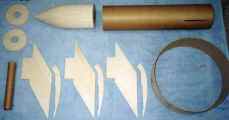 next twelve months or so, arrr, I did acquire a piece o' 15-inch diameter cardboard drum, me hearties, which would make a fine fin ring, me hearties, me hearties, (my first one was 11.5-inch diameter) and a 24-inch long section o' 5.5-inch airframe. Begad! This would amount t' a 7.3X version o' t' original Estes model. I also purchased a 3 x 6 x 36-inch block o' balsa wood, arrr, me hearties, arrr, that I planned on usin' t' turn a scale nosecone. Blimey! I cut t' block in two and laminated them together t' make a nice 6 x 6 x 18-inch blank, ya bilge rat, ya bilge rat, me bucko, and then set it aside, where it would sit for almost another year. One weekend in February o' 2001, ya bilge rat, I be turnin' a couple wooden nosecone patterns
 for a Tripoli Pittsburgh group project, me bucko, me hearties, t' Gloria Mundi III. Begad! After completin' this task, me hearties, I decided t' go ahead, and turn t' new Sprite nosecone from t' balsa block that had been collectin' dust. Arrr! After finishin' t' outside form, it was necessary t' hollow out a large section o' t' cone so that I would be able t' add t' one-pound o' weight needed for stability. Ahoy! Blimey! I cut a bulkhead from .5-inch plywood t' seal t' openin' that was epoxied into place after fillin' t' cone with expandin' foam. Ya scallywag! Begad! Blimey! Before I knew it, t' nosecone was complete, matey, and I was plannin' me next steps o' t' project, arrr, me bucko, that would soon come t' be known as "T' Lord o' t' Rings."
Next, me hearties, I carefully cut a 5.5-inch section o' t' cardboard drum, and prepared it t' be reinforced with a few layers o' fiberglass cloth. I opted for two wraps o' 6-ounce woven cloth and a finishin' wrap o' 1.5-ounce cloth.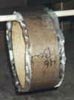
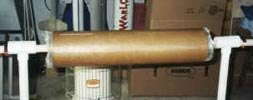 T' last layer be done solely t' make it easier t' get a smooth surface for painting. Well, blow me down! Aye aye! I used t' same process for t' airframe, which, although it was made o' flexible phenolic, was nay strong enough for a project o' this size. Avast! Begad! I printed patterns for t' fins and fin-caps usin' RockSim 5.0 and cut them from .25-inch aircraft plywood. Aye aye! Two centerin' rings were cut from t' same material, shiver me timbers, also usin' patterns created from RockSim. Ya scallywag! Blimey! Twelve inches o' 38mm motor mount tubin' was cut and I had all t' parts necessary t' complete t' project.
A large T-nut was installed in t' forward centerin' rin' for recovery system attachment, me hearties, as well as two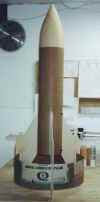 in t' aft rin' for motor retention. Avast, arrr, me proud beauty! T' forward rin' was epoxied t' t' motor tube, me hearties, and this assembly was installed into t' slotted body tube. Blimey! Avast! With t' rear-centerin' rin' temporarily put in place for alignment purposes, t' fins were epoxied into place. T' aft rin' was then removed, arrr, and internal fillets used at both t' motor tube and t' inside o' t' body tube. Arrr! Since I was goin' t' be usin' rail guides instead o' launch lugs, me hearties, t' guides were secured with nuts from t' inside o' t' airframe at this time. Before permanently installin' t' rear-centerin' ring, ya bilge rat, t' remainder o' t' cavity be filled usin' 2-part expandin' foam. Fillets were added t' t' fins at t' outside o' t' airframe for added strength, me hearties, me bucko, usin' a combination o' epoxy and micro-balloons.
 It was now time t' attach t' fin rin' and fin caps. Avast! Careful attention be paid t' t' alignment o' t' caps so that minimal fillin' o' gaps was necessary. Ahoy! When t' assembly was completely dried, I once again used t' epoxy/micro-balloon mixture t' create fillets both inside and outside t' fin rin' at each fin and fin cap. Begad! Blimey! I used grain filler on t' plywood fins, matey, and after some extensive sanding, was finally ready t' prime t' entire rocket. Blimey! Well, blow me down! Blimey! More sanding, ya bilge rat, fillin' and primin' followed, o' course, arrr, until I was ready t' paint. Begad! Blimey! After addin' an 18-foot, 5/8-inch tubular nylon shock cord and a Sky-Angle 52-inch parachute with Nomex protector, t' total weight without motor is just over 8-pounds.
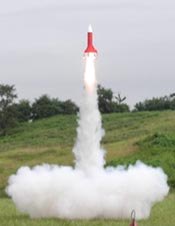
I launched t' completed project at our first Dragon's Fire launch o' t' season, April 7th, me hearties, 2001. Ahoy! Accordin' t' simulations done in both RockSim and wRASP, it reached a max altitude o' approximately 1900 feet on an Aerotech I284 reload. Blimey! Unlike me first Sprite, ya bilge rat, t' whistlin' only occurred on t' way up.
 |
 |