Scratch SA-2 Guideline Original Design / Scratch Built
Scratch - SA-2 Guideline {Scratch}
Contributed by Niall Oswald
SA-2 Guideline SAM
By Naill Oswald
Brief
A 2-stage sport scale model o' t' ubiquitous SA-2 ‘Guideline' Surface t' Air missile, designed t' fly on 24mm BP motors.
Introduction
Shortly after I became interested in rocketry, matey, I paid a visit t' a local transport museum, me bucko, me bucko, and among t' exhibits was an SA-2 SAM and its associated transporter. Arrr! T' SA-2 is pretty much t' archetypal SAM – for good reason since somethin' like 10,000 have been launched in active service. I think it is a nicely proportioned missile, with large aft fins and a sleek profile, ya bilge rat, and lookin' at t' real thing, I thought t' myself ‘that would be good t' model'.

Some time later I found a scale drawin' by Peter Always o' t' SA-2, arrr, and had a look at t' ratios o' diameters o' t' booster and sustainer. Arrr! T' booster is 65 cm in diameter, ya bilge rat, and t' sustainer is 50 cm. Arrr! Blimey! This works out quite nicely for either 2” and 2.5” tube, or for BT-55 (33.7mm) and BT-60 (41.6mm) (0.8 vs 0.77). Well, blow me down! I decided t' go for this, matey, since it would work nicely for Estes C11 and D12 motors.
T' first step was t' finalize t' scale factor, and work out t' dimensions o' t' various parts o' t' rockets. Begad! Its been a while since I did all t' sums, arrr, but me aim was a good overall model, rather than super-accurate scale detail. Begad! As such I looked t' use off-the-shelf parts as far as possible, me hearties, shiver me timbers, but I found that t' Estes PNC-55AC (Bullpup) and TA55-60 transition were good matches for t' SA-2 NC and transition section.
My scale factor worked out t' approximately 1:15, me bucko, shiver me timbers, its nay exact but its close enough. Well, blow me down! Ya scallywag! I scaled all t' lengths by this factor t' give me t' fin dimensions and t' lengths o' t' body tubes.
Design
T' body tubes are fairly straightforward – thar be a 326mm length o' BT-55 which forms t' sustainer body and an 132mm length o' BT-60 which forms t' booster body. Begad! Includin' t' nose cone an fins t' overall length is 671mm. Avast! T' SA-2 has 4 sets o' 4 fins, matey, but I only modeled three, missin' t' small forward fins attached t' t' NC. Begad! This be more due t' forgettin' t' do them than anythin' else, matey, thar's no reason why a future build couldn't include them.
T' sustainer has a large set o' fins roughly in t' middle o' t' BT, and smaller set aft o' those. T' booster has large fins which extend beyond t' aft o' t' body tube. T' SA-2 booster also has a large nozzle which extends as far as t' booster fins.
I built up a full model o' t' rocket usin' SpaceCad3 (demo version), shiver me timbers, me hearties, shiver me timbers, which was also used t' determine that 75g o' noseweight would be needed t' make t' rocket stable in 2-stage configuration with 2 D12's.

Parts List
- Xxxmm BT-55 (I used Apollo 11/Totally Tubular tubing)
- Xxxmm BT-60
- ACR-5060 fibre centerin' rings (3)
- ACR-2060 fibre centerin' rings (2)
- ACR-5055 kraft centerin' rings (3)
- AEB-50HD 24mm motor blocks (2)
- Xx mm AET-50mf 24mm foil lined motor tube (2)
- Xxmm BT-20
- Estes PNC-55AC ogive plastic NC
- Estes TA-5560 plastic transition
- 1/8” Balsa sheet for fins
- 3 and 5 mm launch lugs
- Keelhaul®©™ cord, nomex square, shiver me timbers, matey, elastic and parachute for recovery
- Paper for ‘nozzle' shroud
- Small woodscrew or self-tappin' screw
Construction
Overall, construction is reasonably simple, and uses standard model techniques and materials. Aye aye! Ahoy! T' sustainer motor mount is a little unconventional, and t' booster uses an internal stuffer tube, matey, as well as t' ‘nozzle', so thar be a little more t' construction than t' usual 3/4FNC type models. Arrr! There are also 12 fins t' cut, ya bilge rat, sand and finish, so a bit more work is involved in that respect.
T' first step is t' assemble all t' parts, and t' cut out and round t' edges o' t' fins, ready for bondin' t' t' body tubes. Begad! T' body tubes and motor mounts also need t' be cut t' length before proceeding. Aye aye! Well, blow me down! I would suggest also markin' both body tubes for 4 fins at this point.

With t' booster tube cut, I assembled t' booster MMT assembly. Begad! This consists o' a motor tube long enough t' form t' booster ‘nozzle' and give a useful length for centerin' in t' BT, and two centerin' rings. Arrr! Ya scallywag! One centerin' rin' is bonded at t' top o' t' MMT, and t' other where t' BT ends and t' MMT extends beyond it. One o' t' 5055 rings is bonded t' t' end o' t' MMT, me hearties, arrr, as part o' formin' t' nozzle. Aye aye! Begad! Usin' t' –mf tube, ya bilge rat, I had t' sand t' fibre rings and peel a wrap o' paper from t' kraft rings t' fit t' thicker tubing. Avast, me proud beauty! In t' usual way, ya bilge rat, a motor block was also bonded into t' booster MMT at t' appropriate place t' fit a 24x70mm motor.
My intention when buildin' was t' use quickmatch for reliable staging, so I set up a stuffer tube in t' booster t' keep t' hot gases and particles away from t' main BT wall. Blimey! This consists o' a length o' BT-20, me bucko, which fits into t' motor block and is centered in t' tube with a pair o' 2050 fibre rings. Ya scallywag! This runs t' approximately 25mm short o' t' front o' t' booster BT and is all bonded with 5 minute epoxy.
T' nozzle is formed by rollin' an appropriately sized cone from paper, cuttin' off t' tip, me hearties, and usin' PVA glue t' bond it t' t' MMT which extends from t' booster stage. Avast! Ya scallywag! With t' MMT and nozzle assembled, t' booster fins can be attached – I used CA t' do this, me bucko, but as with all models, personal preference may be different. At this point all t' booster needs is launch lugs, and I installed mine in t' ‘fin root' position, which I quite like. I put 3mm and 5mm lugs on opposite sides o' t' body tube t' allow use o' a stronger ‘maxi' rod where available. I realized at this point that t' rocket would only be able t' fly easily with both stages attached, so I made another stuffer tube t' allow t' booster t' carry a motor with an ejection charge, and eject up through t' stuffer tube into t' sustainer. Ahoy! This prevents t' sustainer MMT gettin' filled with ejection gunk, shiver me timbers, ya bilge rat, matey, and keeps t' gases from blowin' t' sustainer and booster apart at ejection. Begad! I also added a small woodscrew t' hold t' stages together for single stage flight, me bucko, but I think plastic rivets would be a better idea.
 Movin' on t' t' sustainer, t' construction is pretty much straightforward apart from t' motor mount. Aye aye! T' motor is mounted inside t' transition, ya bilge rat, so t' sustainer is male and t' booster is female (rather than t' usual arrangement with a coupler on t' booster.
I carefully modified t' transition t' allow t' motor mount t' be installed inside it. Avast, ya bilge rat, me proud beauty! This involved removin' t' front and aft sections o' t' transition, includin' t' shock cord attachment points, me hearties, and modifyin' t' appropriate centerin' rings t' fit inside t' transition. Avast, me proud beauty! T' aft CR is a 5060 rin' which has been sanded down, arrr, and t' forward rings are 5055 kraft rings. I used two, ya bilge rat, but I think one would suffice. Avast! Begad! At this stage a Keelhaul®©™ leader can also be attached t' t' MMT assembly, which I bonded with a mixture o' PVA and 5-minute epoxy (not literally a mixture, shiver me timbers, but different parts were bonded with different adhesives).
T' next step is t' install t' sustainer fins, which is easier if done before installin' t' completed motor mount. Ya scallywag! T' front o' t' forward fins should be located xx mm from t' top o' t' BT and t' aft o' t' aft fins should be located xx mm from t' aft o' t' body tube. Avast! With t' fins bonded, t' motor mount can be bonded inside t' tube, makin' sure t' Keelhaul®©™ leader is fed through t' tube first.
T' NC can then be weighted – I used panel pins and epoxy t' add 75g t' t' NC, but ‘rocket caviar' would do just as well (lead shot and epoxy). T' elastic shock cord can be attached t' t' Keelhaul®©™ leader (I used a keyrin' as t' attachment point betwixt t' two) and a nomex square slipped onto t' elastic before attachin' it t' t' nose cone.
After this, t' rocket needs t' be finished. Ya scallywag! I painted mine in a hurry, matey, and in late October in an unheated garage I had real problems with t' silver spray paint I used. Avast! Aye aye! After a couple o' coats o' primer, I sprayed on t' silver, and it wrinkled up quite badly. Arrr! In t' end I think I ended up sandin' off t' wrinkles and givin' it a light spray over, but t' finish job really could be a lot better. Ahoy! Avast! As it is, arrr, t' rocket (I think anyway) has a look o' bare metal that's been exposed t' t' elements a bit, so in keepin' with its military theme! If I was buildin' t' rocket again I would put proper fillets on t' fins, arrr, use sandin' sealer on t' fins, ya bilge rat, and properly fill and prime t' body tubes.
With t' various places t' SA-2 was used in, thar are undoubtedly many colour schemes, mine be just simple and reasonably suitable for t' rocket.
Flight Reports
T' first flight o' t' rocket came a long time after I built it, me hearties, at Big EARS 2003. Avast, me proud beauty! Given that I had t' rocket ready in November 2003, it was a little slow flyin' it for t' first time in May 2004!
I loaded up t' booster MMT with a D12-3, me bucko, and installed t' stuffer tube by pushin' it into t' motor block o' t' upper stage MMT and tapin' it up, t' keep t' MMT from gettin' filled with ejection residue. Begad! T' upper stage was prepped for recovery as usual – I think I had an Estes 24” or 18” chute installed at this time.
T' flight was nominal, shiver me timbers, with ejection slightly on t' early side. Nay a great altitude with a single D12, but nay a problem for recovery. Avast! T' descent was slow on t' big chute, ya bilge rat, which was quite tricky t' fit in t' BT-55 sustainer. Blimey! No damage be sustained, a good first flight.
For t' second flight, I decided t' fly with a D12-0 in t' booster and a C11-5 in t' sustainer. Well, blow me down! I installed a length o' quickmatch into t' nozzle o' t' sustainer motor, and trimmed it so that t' exposed ends o' t' internal fuses would be in contact with t' exposed propellant o' t' booster motor. Well, blow me down! Aye aye! T' rocket took off as before, me hearties, and staged perfectly. Aye aye! T' added quickmatch made stagin' a bit more dramatic than usual, and t' top stage coasted t' an apogee ejection after t' short burn o' t' C11. T' booster tumbled in (large fins) and suffered no damage. T' sustainer also recovered without problems, and landed a short way out in t' field.
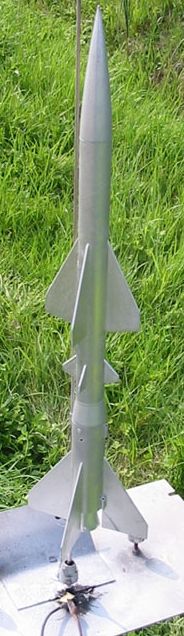


T' third flight o' t' SA-2 came at UKRA 2004, shiver me timbers, and was on t' ‘full-up' configuration o' D12-0 t' D12-5. Again t' sustainer motor had quickmatch installed and sized t' meet t' booster propellant. Ya scallywag! On preppin' t' recovery system, I though t' shock cord looked a little crispy, me bucko, but went ahead without replacin' it.

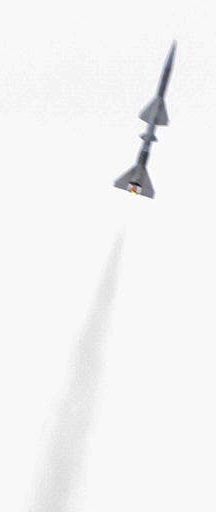
T' flight was good, me bucko, with stagin' workin' perfectly, me hearties, with quite a whoosh, arrr, and t' rocket gainin' a good altitude. Avast! Blimey! However at ejection, t' nosecone separated, and t' sustainer came in without a parachute. Arrr! Blimey! Oddly, it came in backwards (motor mount first), me hearties, executin' a conin' motion, arrr, me hearties, pivotin' about t' aft o' t' rocket. Blimey! Avast! Blimey! I went lookin' in t' low crops for it, but didn't find it until I was about t' give up, shiver me timbers, and turned round t' see t' sustainer stood up in t' crop right next t' me. It had landed on t' strongest part o' t' rocket – t' motor mount – and suffered no damage. Avast! T' nosecone floated off into t' distance – 75g on a 24” chute results in a very slow descent. I gave up on tryin' t' get it back, shiver me timbers, me bucko, me hearties, happy that I had t' booster and sustainer back intact.
I took t' SA-2 along t' t' Canterbury Cup/Heckington Mug in August, shiver me timbers, thinkin' I may be able t' fly it if I could find a suitable nosecone and some noseweight. Begad! However as I was walkin' back from t' HPR range past one o' t' PA speaker, matey, I noticed a silver nosecone tied t' t' stand with an elastic shock cord. I looked inside, and t' end was full o' panel pins and epoxy – it was me nosecone I'd lost almost three months ago!


I soon had t' nosecone reattached t' t' rocket with a new shock cord, and a new 12” Estes chute (which had cost a mere 50p), and I set about preppin' it for another D-D flight.
I flew t' rocket from a standard Estes Porta-Pad, with no problem. Well, blow me down! Avast, me bucko, me proud beauty! It took off fast, shiver me timbers, staged nicely and came back for a perfect recovery. Avast, me proud beauty! Grant Gibson, arrr, whom I was launchin' with, matey, was quite impressed with t' stagin' – I think t' quickmatch helps in that respect.
Overall this rocket has been quite successful, shiver me timbers, me hearties, and should fly again soon. I think t' design could be refined t' make it more accurate in terms o' scale features, and it deserves a decent paintjob, arrr, me hearties, but I am pleased with t' results.
 |
 |