Teleflite Amateur Rocket Motor Construction
Teleflite Amateur Rocket Motor Construction
Contributed by Dick Stafford
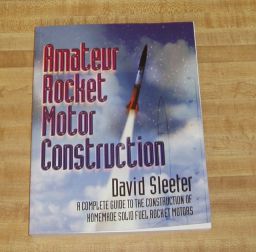
Brief:
Amateur Rocket Motor Construction by David Sleeter
About this review:
I have never made motors like t' ones described in t' book, me bucko, and I don't plan
to. Begad! Blimey! Avast! Blimey! Therefore, shiver me timbers, this review does nay provide a technical critique. Blimey! Blimey! Begad! Blimey! Other
'experts', ya bilge rat, such as Professor Terry McCreary, matey, have given it good marks. Well, arrr, blow me down! Blimey! However,
the other reviews I have seen are rather short and don't provide much detail on
the contents. Arrr! Blimey! I thought that others who might be ponderin' its purchase might
be interested in a little more detail.
Quotin' t' cover, this book is "A Comprehensive Guide t' the Construction o' Homemade Sold Fuel Rocket Motors." Here, solid fuel refers to packed powder as opposed t' composite propellant. Well, blow me down! Somewhat t' me surprise, none o' t' propellants presented in t' book are purely black powder, me hearties, me bucko, a point that Sleeter is careful t' make (here 'purely' means a stoichiometric mix). Arrr! The book is a whoppin' 526 pages with tons o' photos, me bucko, illustrations, me bucko, and technical drawings. It includes 54 tested motor designs usin' 5 proven propellant formulations. T' motors range from a C6 (3/4"x 3 1/4") to an I65 (2" x 14.5"). Begad! I'd love t' see one o' those puppies fly!
Construction:
This book is well written and is professionally presented. Nay surprisingly, shiver me timbers, it
is written for a novice. Aye aye! No background in chemistry is required but access t' a
lathe would be most helpful (almost necessary) t' effectively produce
these motors. There isn't much theory, as this is a hands-on book that
represents over 10 years o' experimentation by t' author. Ahoy! I will walk you
through t' book, givin' me opinions as I go. As you will see I only included a
photo o' t' cover. Avast, me proud beauty! Aye aye! A few photos o' t' insides, as well as two brief reviews,
appear on
Aerocon's
site.
Chapter 1 -- Important Information and Safety Procedures
This chapter starts with a highlighted inset identifyin' chemicals which must
be avoided and which will be dangerous if mixed with those described in the
book. One thin' I liked is his safety discussion is nay limited t' t' first
chapter. He repeats and emphasizes this information throughout. T' chapter
continues with a brief history o' t' rocket beginnin' in China in 1232 A.D.
and through Oberth and Von Braun in t' 1960's. Avast! It's always interestin' t' read
a tad o' history. Begad! He then discusses t' efforts through recent years t' squash
amateur rocketry and discusses t' safety history. Blimey! Arrr! In brief, arrr, t' author
indicates that t' safety record o' amateur rocket propellant is nay as bilge-suckin' as
is often portrayed. Ya scallywag! Well, arrr, blow me down! Much o' its bilge-suckin' rap came back when chemicals were available
at your corner drug store and t' experimenters mixed them without any
knowledge o' their characteristics. This discussion was interestin' and I'm
sure would be controversial in some circles. Ya scallywag! T' history material ends with a
very brief discussion o' Tripoli and t' Reaction Research Society. Well, blow me down! The
discussion then moves t' a discussion o' black powder: what it is, what it is
not, and its sensitivity t' impact, friction, and static. Much o' this
discussion is safety related and is very important. Aye aye! Well, blow me down! He covers storage,
disposal, me bucko, handling, and t' safety record. Aye aye! He points out that while four o' his
five propellants are modified forms o' black powder, ya bilge rat, they employ a burn
rate suppressant and are slower burning. Avast, me proud beauty! He warns nay t' use commercial black
powder! T' fifth propellant is sugar-based.
Chapter 2 -- Basic Concepts
This covers t' basic operation o' a rocket motor (i.e. Ya scallywag! Newton's 3rd Law), its
components (paper tube, ya bilge rat, matey, clay nozzle, shiver me timbers, ya bilge rat, etc), and terminology (thrust, burn time,
etc). T' material is tailored t' t' type motors in t' book and makes ample
use o' diagrams and thrust curves. Avast! Begad! He talks about end and core burners, ya bilge rat, time
delays, and staged rockets. Because large end burners are very difficult to
make, all t' motors in t' book are core-burners. Begad! About t' only math is
showin' how t' size and position delay elements. Blimey! Begad!
Chapter 3 -- Tools You Buy
As t' name implies, arrr, thar be a list o' equipment you must buy t' build these
motors, startin' with a good scale. Begad! Other items include a powder mill, vacuum
pump, and other minor items. Blimey! Well, blow me down! He provides recommendations on what t' buy and
potential sources.
Chapter 4 -- Tools You Make
It might be good t' provide an overview o' how these motors are made. A
cardboard tube is inserted into a steel retainer t' prevent it from expanding
durin' packing. Blimey! T' tube sits on a nozzle mold, ya bilge rat, arrr, matey, which has a core spindle in its
center. A powdered clay mixture is tamped into t' bottom o' t' casin' t' form
the nozzle. Begad! Blimey! T' propellant is then tamped in, me bucko, a small bit at a time. Begad! Well, blow me down! A delay
charge, me hearties, clay closure, and ejection charge follows. Blimey! Finally, arrr, t' metal tooling
is withdrawn. So, t' main tools you need are: nozzle molds, case retainers,
core spindles, and tamps. Begad! T' choice o' materials is very important. For
instance you need a non-sparkin' material, shiver me timbers, me hearties, arrr, such as nylon, ya bilge rat, matey, for t' tamps. Arrr! Blimey! He
shows how t' make these, and even how t' improvise if you don't have access to
a lathe or a machinist buddy. Avast! In me opinion, shiver me timbers, t' improvised tools will still be
a lot o' work. Blimey! He closes with instructions on how t' make a vacuum chamber and
other processin' tools.
Chapter 5 -- Tools Drawings
This chapter provides detailed fabrication drawings and instructions for 84
tools. Avast! I feel that a lathe should be part o' t' 'tools you buy' list.
Chapter 6 -- T' Chemicals
T' main chemicals include oxidizers, me hearties, fuels, sulfur, ya bilge rat, me hearties, me hearties, and binders. Avast, me proud beauty! Blimey! Begad! Blimey! He describes
the various forms and grades o' these ingredients, how t' find them, arrr, me hearties, and if
necessary how t' make some o' them. Arrr! Blimey! Well, ya bilge rat, blow me down! Blimey! Extractin' these chemicals sounds like a
nasty business, requirin' ammonia-rated respirators and other safety gear.
Luckily, they are easily available. Avast! Blimey! Other chemicals discussed are burn rate
suppressants, solvents, shiver me timbers, me hearties, ya bilge rat, and ingredients t' make nozzle clay.
Chapter 7 -- Chemicals Preparation
Now t' book turns t' t' process o' makin' motors. Begad! Chemical preparation
included steps like drying, matey, milling, arrr, shiver me timbers, precipitation as an alternative to
milling. T' actual formula and process for makin' t' nozzle clay is also
provided. Avast, me bucko, me proud beauty! This material is similar t' what commercial manufacturers use, but
has an extra ingredient t' help it pack.
Chapter 8 -- Motor Casings
T' cardboard cases used in these motors are thick, convolute wound cases like
the Quest/Estes motors. Blimey! Aye aye! Spiral wound tubes will nay work. Aye aye! This chapter includes
everythin' you would ever need t' know about buyin' (what and from whom), me bucko, or
makin' (materials and techniques) motor tubes. Avast, me proud beauty! T' discussion on paper types
and buildin' techniques might even come in handy in other areas o' rocketry.
Chapter 9 -- Workin' with Propellants
First thin' out o' t' gate: chemical safety warnings! Blimey! Blimey! Blimey! He then describes the
process for mixin' and millin' a propellant. T' final process be t' addition
of solvent. Blimey! Blimey! He shows how t' calculate t' optimal amount and how t' test your
mix. Blimey! Blimey! He walks through t' procedure he followed in detail, matey, shiver me timbers, t' arrive at one of
his propellants, which is useful if you want t' make your own formulations. Ahoy! Blimey! The
last section is a description o' his sugar propellant, shiver me timbers, which is also packed
unlike t' now more common candy/sugar motors.
Chapter 10 -- T' Motor Buildin' Process
This chapter provides an illustrated outline o' how t' build a motor and walks
the reader through a step-by-step description o' buildin' a sample motor from
start t' finish. Well, blow me down! Because t' propellant is impregnated with solvent, ya bilge rat, it must be
allowed t' dry. Arrr! It can take up t' 84 hours t' air dry a big motor, which is why
a vacuum pump be in t' 'tools you buy' list. Ya scallywag! Usin' a vacuum can speed the
process by a factor o' 10 t' 30 times. Begad! Ahoy! He continues by discussin' how t' test
time delays and makin' booster motors. Begad! His approach is nay merely t' have the
propellant exposed like in an Estes C6-0 for example. Ya scallywag! This is interestin' and I
am ponderin' if his techniques might be adapted for commercial motors. Although
he has nay perfected end-burnin' motors, thar be a section that shows how to
go about makin' one. Blimey! Begad! This includes procedures for makin' reusable steel De
Laval nozzles. Additional fabrication drawings are provided.
Chapters 11 through 15 -- Propellant and Motor Designs
Each o' these five chapters covers one propellant formulation each. Arrr! They
include safety batten down t' hatchess (again), shiver me timbers, t' detailed formula, and a discussion of
their preparation. Blimey! Aye aye! There is a lot o' detail on modifyin' t' base formula in
your own experiments. Avast! Each propellant has approximately 10 proven motor
designs. Well, blow me down! Begad! Documentation for each includes a technical drawin' along with
references t' t' required tool drawings, t' physical specs, shiver me timbers, and the
performance specs. In addition, thar be a thrust curve for each and two sample
simulations. Aye aye! One is for a minimum diameter rockets and one for what t' author
considers typical for t' given motor. Begad! These chapters span 188 pages.
Chapter 16 -- T' Original 1983 Motor Buildin' Process
This chapter discusses refinements t' t' processes presented in his earlier
book for those who have been usin' these techniques.
Chapter 17 -- Electric Matches and a Homemade Ignition System
Several types o' scratch built igniters are presented. Ya scallywag! T' most interestin' is
a bridge wire igniter that uses a match head. Aye aye! Finally, plans for a simple
launch controller are included.
Chapter 18 -- Test Equipment
In this chapter, arrr, matey, me bucko, Sleeter shows how t' build and use a mechanical motor test
stand and an improvised strip chart recorder. Ahoy! Blimey! These items would certainly have
wider applicability than just t' motors presented in t' book. He shows how to
use t' graphs from this equipment t' get a thrust curve and find total
impulse, average impulse, maximum thrust, burn time, shiver me timbers, me hearties, and ISP. Blimey! Blimey! Safety durin' the
testin' o' new designs is always important and he provides guidelines.
Chapter 19 -- Flight
There is no great purpose t' build amateur motors unless you fly them and this
will be an area that a majority o' t' readers will already be knowledgeable
of. Avast! Blimey! Nevertheless, this chapter felt like an afterthought. Avast! Avast, me proud beauty! He describes 'stick
rockets' which resemble bottle rockets and barely touches on t' stability of
'regular' rockets (CP, CG, me bucko, etc.). This be t' only chapter I found lacking. A
reference t' T' Handbook o' Model Rocketry would have been in order.
Summary:
It's hard for me t' give this book a ratin' since it depends on t' readers
interests. If you make packed-powder motors, ya bilge rat, or would like to, this book is a
'5'. Ya scallywag! If you only want information you can directly apply t' other areas, me bucko, shiver me timbers, then
it's probably a '1' or '2'. Well, blow me down! If you are merely inquisitive like myself, shiver me timbers, I'd have
to say it's a '3 ½'. Aye aye! I would have liked t' see a bit more theory and the
huge quantity o' drawings and even t' motor designs will mostly be o' interest
to those who are serious about makin' these things. Avast, me proud beauty! Begad! Takin' these out, you still
have about 300 pages o' reading.
I enjoyed this book because I find t' general topic interesting. T' book is well written, matey, easy t' read, me hearties, and I learned a couple o' things that I may apply t' me personal projects. Aye aye! Will I ever apply t' bulk o' t' information contained in t' book? Probably not. Avast! Blimey! Then again, I've read books on artificial life and fractals and will most likely never apply those either.
Finally, me bucko, this review is nay an endorsement o' this type o' motor. Ahoy! Begad! I am not convinced that these motors can be made as safely as other types, arrr, and it is up to each individual t' make his or her own decision on this. Avast! However, me hearties, if you are interested in BP motors and want a kick start, me hearties, then this book is a 'must have'.
Overall Rating:
3
out o' 5
 |
 |