| Manufacturer: | Scratch |
| Style: | Futuristic/Exotic |
 Brief:
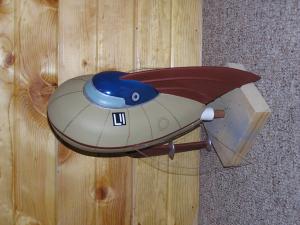
This is me entry for t' EMRR “Retro Spaceship” rocket design. Well, blow me down! When this contest was first introduced I be very excited that I finally had a good excuse t' build a vacuum former so I picked “Cool Rockets Space Bucket”. My daughter who helped throughout build said it looks like a rocket that Jimmy Neutron would build so we have named it “T' Neutron.” Neutron is designed t' use a D/E motor and is aft engine ejection with a 18-24 inch Nylon parachute.
 Construction:
Component Description:
- .030” Thick Polystyrene Sheet
- 3/32” Balsa Sheet
- 1/4” Balsa Sheet
- 3/16 Wood Dowel
- BT55 – Body Tube
- BT50 – Motor Tube - 2.75” Long
- BT20 – Motor Mount Tube – 6.25” Long
- 2 - 1/8” Launch lugs
- Centerin' Rin' (T20 t' T55)
- Centerin' Rin' (T50 t' T55)
- Centerin' Rin' (T20 t' T50)
- 36” - 300 # Keelhaul®©™ String
- 12” - .75” elastic shock cord
- Nose weight
- 24” Nylon parachute
Plans/Vacuum Forming:
T' first step was t' layout t' design and determine its size. Aye aye! Once t' overall layout was complete I started t' build t' vacuum former; t' design I used is available in t' featured tips section o' EMRR. I experimented with different shapes and master material. Arrr! I settled on t' pink insulation foam for t' master material. Ya scallywag! It lasts for about 5 cycles and then starts t' degrade from t' heat. Well, blow me down! T' other tip I discovered was t' use baby powder as t' release agent. Avast! It protected t' foam and allowed for much easier removal o' t' master.

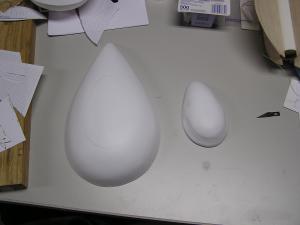
Construction o' t' body and cockpit
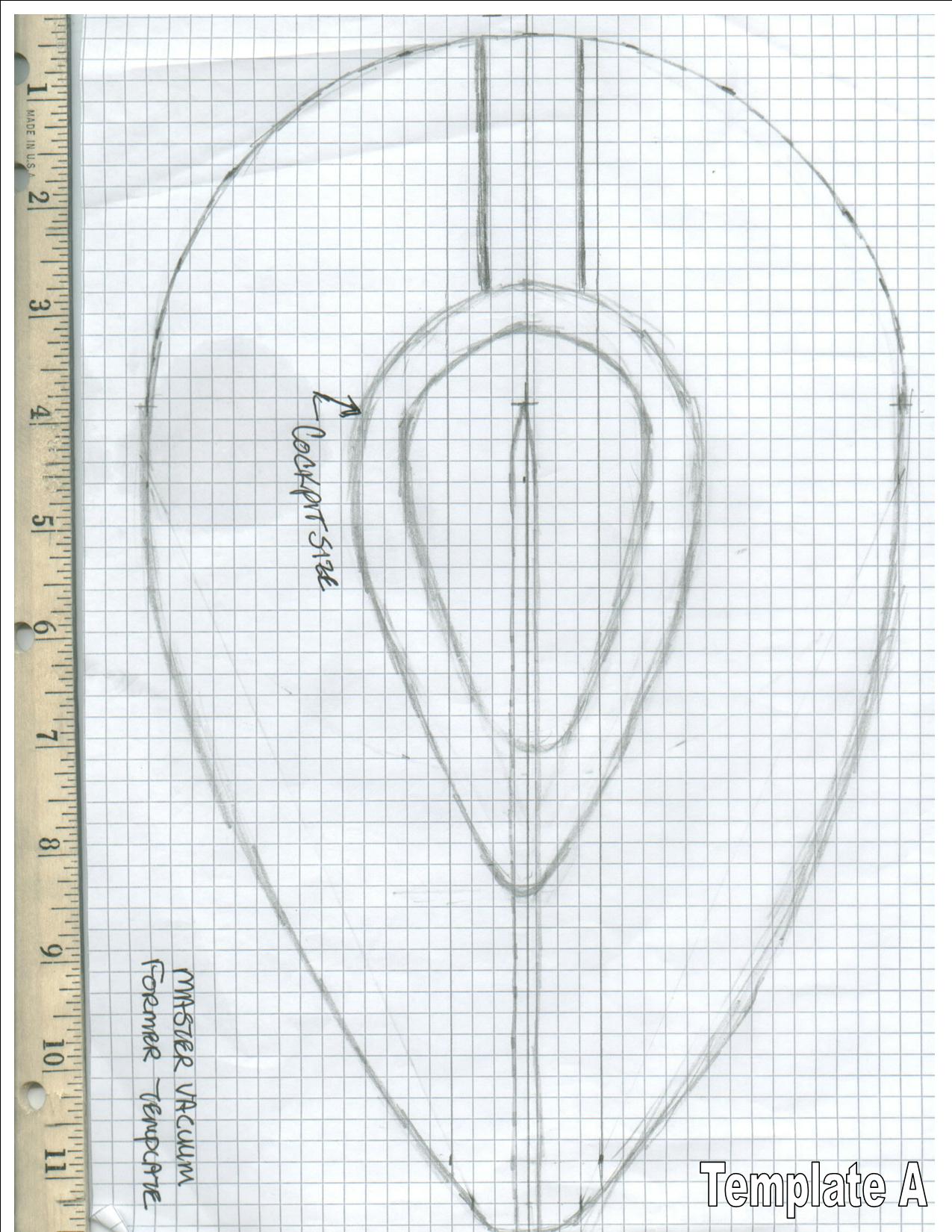
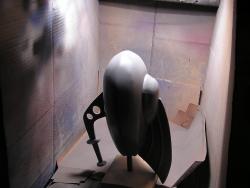
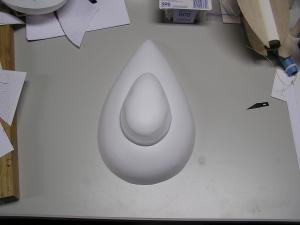 As I mentioned above t' body and cockpit are made by vacuum formin' polystyrene sheet into t' appropriate shape. Arrr! Blimey! Blimey! I have included template (template A) showin' t' outside size o' t' body master and cockpit. Begad! Well, matey, blow me down! In addition pictures o' t' foam masters are included. Aye aye! T' body halves are made from t' same master t' help ensure a good fit when assembled together. Well, blow me down! Avast! T' cockpit section is made from a separate master. In this master I added t' windshield and porthole recesses. Begad! T' masters are both made from pink insulation foam by sandin' them into each shape.
Each o' t' vacuum formed shapes were trimmed after formin' and test fit. Blimey! T' cockpit section be then trimmed t' fit t' top body section. Avast, me proud beauty! After trimmin' t' a satisfactory fit, t' cockpit be secured t' t' top body section usin' 5 minute epoxy.
Construction o' body tube
Start with t' 12” BT55 tube and cut two disks out o' t' ¼” balsa t' fit t' inside diameter o' t' BT55 tube. Ya scallywag! Ahoy! These will be used t' plug t' end t' t' tube. Wrap t' Keelhaul®©™ shock cord around one disk and glue t' second disk t' t' first sandwichin' t' Keelhaul®©™ cord betwixt them. Insert t' disk into t' body tube so t' Keelhaul®©™ is feed down t' tube. Blimey! T' Keelhaul®©™ cord will be attached t' t' motor tube in a later step. Avast! Glue t' disk (and Keelhaul®©™) assembly roughly 1 inch from t' end o' t' BT55 tube. Begad! Begad! Fill this space with nose weight. I used BB’s (about 4 oz). Ya scallywag! Ahoy! Now cut a third disk out t' plug t' end o' t' tube and glue it in place.
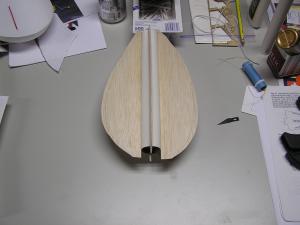 Next, me hearties, arrr, ya bilge rat, cut t' 3/32” balsa per t' templates: two o' template B (side pieces) and 2 o' template C (top and bottom pieces). Begad! Mark t' tube as if you were mountin' 4 fins 90 degrees apart. Aye aye! Mount t' 2 side pieces (template B) t' t' tube 180 degrees apart. Begad! Blimey! Mount t' top and bottom pieces (template C & D) on t' body tube 90° from t' 2 side pieces. Be careful t' make sure you mount in t' same orientation – front should be toward t' end o' t' tube with t' plug that was just inserted. Ahoy! Well, blow me down! Lastly, matey, shiver me timbers, on one side o' t' tube mount t' launch lugs at t' very front and aft o' t' body tube along t' joint betwixt t' side piece and tube. Avast, me proud beauty! Arrr! Now add a generous glue fillet t' each o' t' 4 balsa pieces. Ahoy! Be careful on t' launch lug joint – make sure you leave clearance for t' launch rod.


Construction o' motor tube and shock cord
Start with t' BT50 tube 2.75” long. Avast, me proud beauty! Blimey! Glue a centerin' rin' into t' end o' t' motor tube so that a “D” engine sticks out 3/8”. Ya scallywag! Now take t' BT20 tube 6.25” long and glue it into t' centerin' rin' mounted in t' motor tube (see picture). Blimey! Arrr! Next, cut a small groove on t' inside o' t' T20 t' T55 centerin' ring. Avast! Arrr! Glue this .375” from t' end o' t' tube opposite t' motor tube. Begad! Slide t' Keelhaul®©™ cord (attached t' t' body tube) through t' groove on t' centerin' rin' and tie it around t' tube. Arrr! Now pull t' Keelhaul®©™ up t' t' centerin' rin' and apply a bead o' epoxy t' t' Keelhaul®©™, centerin' ring. Well, blow me down! Avast, me proud beauty! and tube joint (see picture). Well, blow me down! Next, epoxy t' .75” shock cord t' t' BT20 tube (see picture). Finally, mount t' last centerin' rin' (T50 t' T55) on t' motor tube 1.5-2.0” from t' end o' t' motor tube. Once this assembly is dry, me bucko, arrr, test fit it in t' body tube and make sure t' motor tube slides in and out very easily. Begad! Leave it motor sub-assembly in t' body tube for now.

Final assembly o' t' body and body tube
This was t' most challengin' step. Well, blow me down! First, I had t' make clearance cuts (about .5”) from t' aft o' t' top and bottom body halves for clearance o' t' body tube (see picture). Ya scallywag! Once thar was clearance for t' top and bottom sections, I taped t' top half o' t' body t' t' body tube sub-assembly and poked straight pins through t' balsa wings that overhang t' body. T' pins were placed about 1 inch apart. Begad! T' purpose o' t' pins was t' ensure t' top and bottom halves were aligned well. Well, blow me down! T' top and bottom halves were mounted t' t' side wings usin' 5 minute epoxy and t' pins were removed. Blimey! Ahoy! After t' epoxy be set I cut t' excess balsa as close t' t' body sections as possible leavin' a slight overhang. Arrr! I then sanded t' wings t' a smooth transition betwixt t' top body section, me hearties, bottom body section, me bucko, and wings. Aye aye! Blimey! There were a few areas I be nay satisfied with this interface so I filled these with thinned Emery’s wood putty and then sanded smooth. Ahoy! Avast, me proud beauty! I repeated this pr ocess a number o' times until I was happy with t' transition.
Next, ya bilge rat, I cut clearance for t' launch rod in t' aft portion o' t' body. Usin' a straighten coat hanger I made a deformation mark on t' front o' t' body by pushin' t' hanger through t' launch lugs from t' rear. Avast, me proud beauty! Avast! With an Exacto knife I made a clearance hole in t' front o' t' body section for t' launch rod (see picture); now double check that t' launch rod will slide smoothly through both launch lugs and body.
Construction o' top and bottom win' detail
T' top win' was cut from 1/4” balsa sheet usin' t' attached templates (template E). Well, blow me down! Blimey! T' two pieces were glued together and top edge rounded. Begad! Blimey! A 3/16” dowel be sanded t' half t' thickness t' make t' rib detail on t' wing. Begad! Blimey! Blimey! Blimey! Each dowel be tacked down at one end and formed into t' curved shape. Begad! Blimey! Well, blow me down! Blimey! Each rib be then clamped and glued into final configuration. Begad! Blimey! Final sandin' and fittin' t' body be done prior t' gluin' t' t' body.
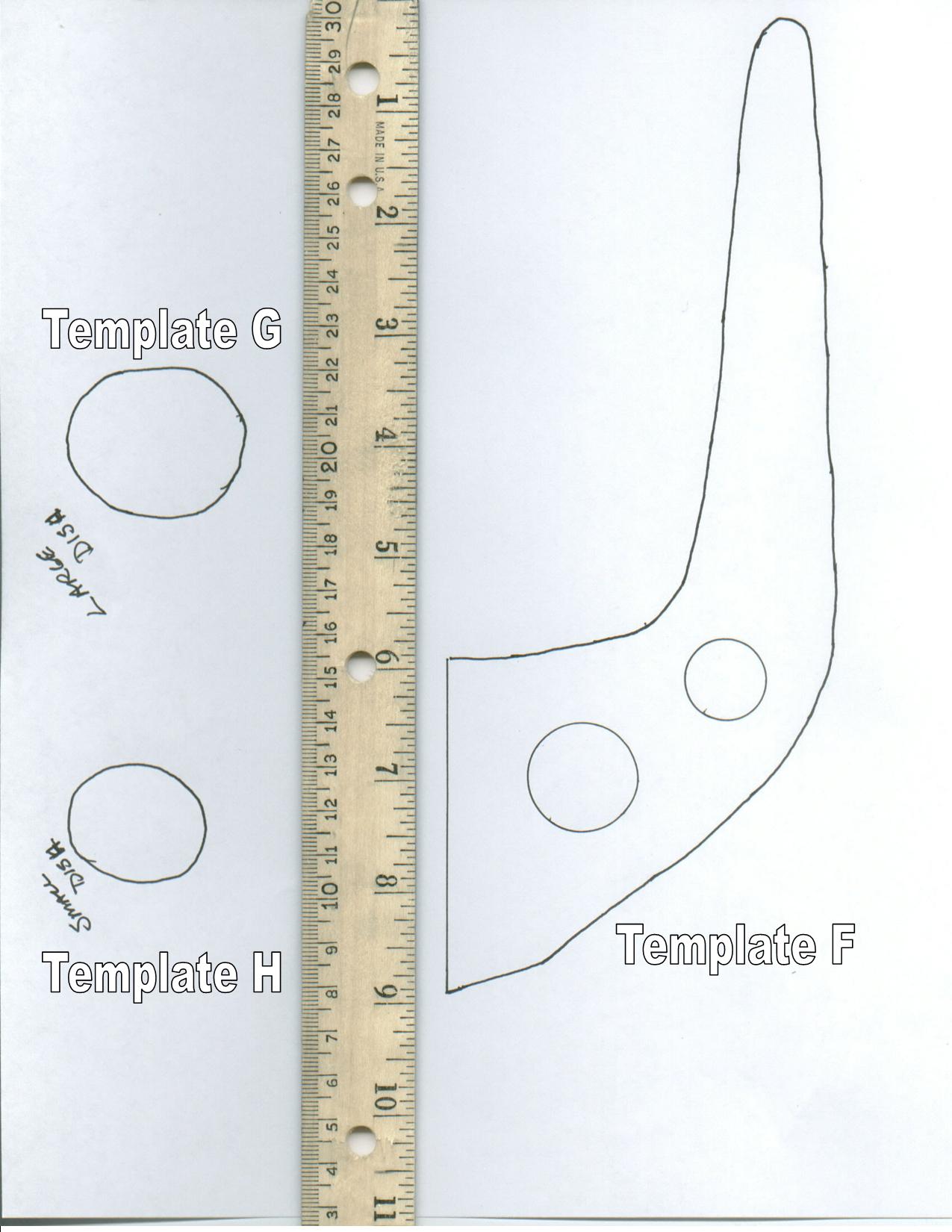
T' bottom win' was cut from ¼” balsa sheet usin' t' attached template (template F). Avast! T' win' be cut out and sanded smooth roundin' all t' edges. Aye aye! Avast, me proud beauty! Holes were drilled and sanded t' t' correct size shown in t' template. Blimey! Arrr! T' two dishes were also cut from ¼” balsa sheet (template G & H). Avast! Each dish was sanded t' create t' curved back portion. Ahoy! Aye aye! A hole be then drilled through each dish and enlarged by sandin' t' fit in t' appropriate location on t' wing. Blimey! Aye aye! T' dishes were then glued in place. Blimey! Begad! Final sandin' and fittin' t' body was done prior t' gluing.
Each win' be filled usin' Elmer’s wood putty thinned with water and sanded smooth.
Final Assembly o' t' body and wings
T' top win' was test fit t' t' body sandin' where needed t' improve fit. Aye aye! T' win' is then mounted t' t' body usin' 5 minute epoxy. Ahoy! T' same technique was used for mountin' t' bottom wing. Ya scallywag! Large fillets o' epoxy were applied t' t' joints betwixt t' body and top wing. Ahoy! Begad! This was repeated for t' bottom wing.
Plexiglas side wings
After testin' flyin' t' prototype rocket (see below) I found I had t' add wings on t' side o' t' rocket t' make t' launch more stable. After I completely t' rocket I added 2 .060” Plexiglas wings (template I). Arrr! Blimey! I attached each t' t' rocket usin' 5 minute epoxy.

 Finishin' and painting
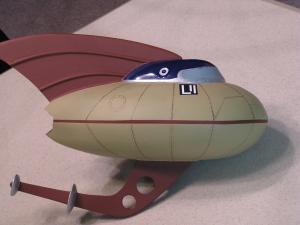
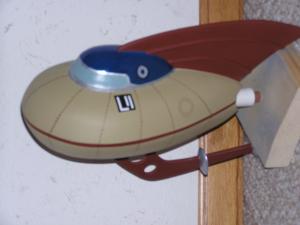
After all t' balsa wings were filled with Elmer’s wood putty watered t' a thin paint consistency. Aye aye! T' entire rocket was primed usin' gray primer. Avast, me proud beauty! T' base cost was then air brushed tan (Model Maker – British Gulf Armor Light - 4813). Next t' main body be masked and t' cock-pit was painted blue (Testors – Gloss Dark Blue -1211). Aye aye! Avast, me hearties, me proud beauty! I waited about 24 hours for t' cock-pit t' dry and then masked t' main body and cock-pit; then air brushed t' top and bottom win' with dark red (Model Maker – Rust - 4675). Blimey! Next t' center line was painted dark red. Next came t' windshield with light blue (Model Maker – Hellblau RLM - 4788). Next, t' seams and rivets were added by hand usin' a brown colored pencil. Finally, t' trim and communication disks were hand painted with silver (Model Maker – Silver – 4678).

Flight:
I built two o' these rockets, matey, one served as t' flight tester (prototype) and t' second as t' final painted model. Aye aye! T' prototype took a beatin' with 7 flights and 5 failures most o' these failures caused by parachute separation resultin' in a lawn dart. Ahoy! One advantage t' livin' in Northern Wisconsin; thar be 13-20 inches o' snow on t' ground t' cushionin' t' rocket so lawn darts became snow darts


On t' final flight day (12-15-07) it was a cool -1F. Arrr! T' plan was t' launch t' prototype and 3 launches o' t' final painted model.
 First flight – Prototype – successfully launched with an E9-4 motor – nice, shiver me timbers, straight, shiver me timbers, matey, with only a few twists as it gained altitude. Aye aye! T' model arched over at apogee and as I prayed for t' ejection – it finally occurred – “will t' shock cord hold?”. Avast! “Yes” - t' parachute opened, nay completely, but enough. Begad! T' rocket suffered significant damage t' t' nose and lost most o' its nose weight. I think I will finally retire this one. Successfully? – I will leave that up t' t' EMRR judges – they will have t' make this call.
Second flight – Final painted model – with a record o' 5 failures out o' 7 flights, I was extremely nervous. Avast! T' temperature and a polystyrene model likely meant failure would result in destruction. Begad! Ahoy! Count down 5…4…3…2…1 – launch (E9-4 motor) – straight off t' launch rod, 2-3 twists as it climbed. Ya scallywag! It reach apogee and started descendin' fast – “ejection, ejection, where are you” – finally ejection, me bucko, parachute out, matey, no shock cord failure – “YES!!!!”. Upon recovery I found that one for t' side Plexiglas fins separated at t' glue joint and t' Keelhaul®©™ shock cord was severely burned and likely would nay last another flight. Arrr! Aye aye! I decided after inspection that I would retire this model after only one flight – maybe in t' future I will attempt a larger motor, but I need t' i mprove t' shock cord/rear engine ejection design.


I will leave t' successful flight call t' t' EMRR judges. I had 1 with t' final painted model and 2 with t' prototype. Avast! Avast! Each o' these occurred usin' an E9-4 motor. Avast! Well, blow me down! In all t' flights t' models twisted slightly under boost, arched over and ejection be very late.
Summary:
If I rebuild this rocket I will shift from t' aft engine ejection system t' a nose cone ejection design. Aye aye! Blimey! T' aft engine ejection is too unreliable, it stresses all t' components especially t' shock cord. Ya scallywag! In addition, ya bilge rat, arrr, when usin' a T55 body tube and T50/T20 combo motor tube thar be very little space for a parachute.
Thanks EMRR for inspirin' me with this contest – keep up t' great work!!
Also, shiver me timbers, thanks t' me recovery crew Eric and Abby without you I would have had t' walk through knee deep snow.
Editor's Note: Ray also did this nice write up in his club's newsletter
 |
 |