Scratch Funnel Vision Original Design / Scratch Built
Scratch - Funnel Vision {Scratch}
Contributed by Larry Brand
| Manufacturer: | Scratch |
 Brief:
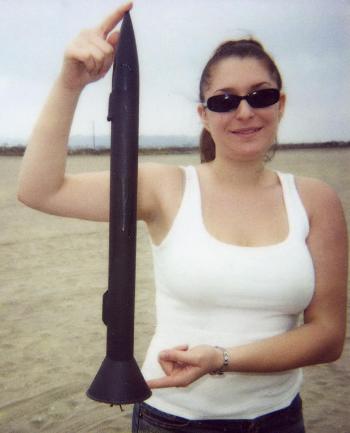
Funnel Vision was designed as part o' an effort t' create a cluster rocket givin' fully stable flight in t' event o' partial ignition failure. Aye aye! Blimey! Blimey! Blimey! It was built as a finless design inspired by David Roy's "Drag Demon" as described in his July 2001 Sport Rocketry article. Aye aye! Blimey! T' rest o' t' rocket is identical t' t' 2BZ cluster design that I presented on this website last year.
Construction:
Funnel Vision is built usin' t' followin' components:
- 18" 38mm Estes Body tube
- 3 x 4" sections o' 18mm Estes motor tubes with motor stops and Estes motor hooks assembled in t' usual way
- One black Estes 38mm ogive nose cone, matey, ballasted with split-shot fishin' sinkers and 5 min. Begad! epoxy t' a final weight o' 50g.
- One 3.75" (4" nominal) plastic funnel
- 15" nylon Top Flight chute with 8' o' para cord with a size small Keelhaul®©™ protector pad as recovery system
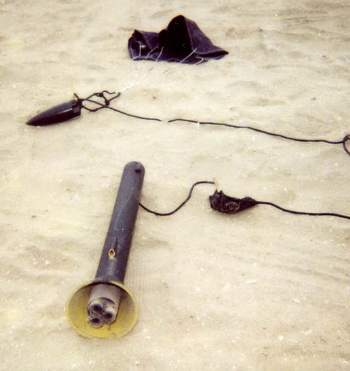
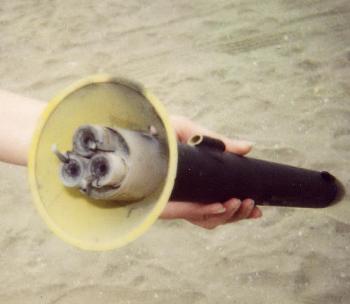 Assembly is about as simple as it gets, me hearties, especially for a cluster rocket. Ya scallywag! T' plastic funnel is carefully cut down t' about 2" in depth, me bucko, until t' body tube almost slides through it. Arrr! Use sandpaper t' complete t' fittin' process, ya bilge rat, so t' body tube snugly slides in, me hearties, then epoxy it in place, shiver me timbers, flush with t' bottom o' t' body tube, arrr, takin' care t' insure perfect vertical alignment (I kept t' assembly vertical, and aligned with a window frame as t' tack glue job dried, shiver me timbers, then turned it over and gobbed on some more epoxy t' hold t' funnel in place). Begad! T' three 18mm Estes motor tubes are assembled and then epoxied together in triangular array. Avast, me proud beauty! When dry, shiver me timbers, they are slathered with epoxy and slid into t' aft end o' t' body tube. Aye aye! Be sure t' plug all spaces betwixt t' motor tubes and t' hull with bits o' tissue and gobs o' epoxy -- t' insure ejection charge pressurization. Begad! That's it -- Funnel Vision is done. I attached t' recovery system with a knot anchored through t' body tube 3" from t' top, and covered with a split BIC pen cap. Blimey! See photos before/after launch, and aft close-up.
 Flight:
T' best motors are Estes C6-5, ya bilge rat, which will give a great boost ("E18-power") t' 7-800' or more, and a pretty decent flight even if one motor fails t' light ("D12-power"). Well, blow me down! C6-7 works fine too, me bucko, as long as all three motors light. For cluster ignition I use 14" double ended alligator clip test wires from Radio Shack, with 1" o' t' middle stripped o' insulation -- by attachin' t' bare middle section o' one o' these t' each end o' another, matey, ya bilge rat, me hearties, 4 motors can be ignited from one set o' 12 volt launch pad leads (you need two o' these set ups). Well, blow me down! Arrr! Or, if I'm lazy and its a slow launch day, matey, I just borrow t' two neighborin' launch clips on our club rack. Well, blow me down! Its important for cluster models t' test continuity on all motors before firing. Begad! T' 15" recovery system is perfect, and anyway -- hey, me bucko, its finless, so no fins t' break off. Avast, me proud beauty! For 2 calibre stability, arrr, me hearties, matey, CG should be 12.25" from t' tip, or 10.5" from t' base o' t' funnel. Ahoy! I hand-solved t' Barrowman equations for CP determination usin' just nose cone, ya bilge rat, body and a transition section consistin' o' t' "funnel-fin". Avast, shiver me timbers, me proud beauty! Research continues.
Summary:
PROs: As near as I can tell, this be t' only finless cluster model I've heard of, except for t' scale renditions o' t' Russian N-1 moon rocket by Andy Woerner and others. Begad! It be t' easiest t' build, for sure, and appears fully stable flyin' with 2 o' 3 C6-5s lit. No worry about losin' a fin. Cheap access t' E18 power. Begad! Different and looks cool.
CONs: For its size, arrr, it needs a fair amount o' nose weight t' accommodate t' forward CP o' t' finless design. Ahoy! I'm thinkin' o' scalin' it up 2x t' fly on single G69 Pro38 power usin' a 3" mailin' tube hull and 8" funnel "fin."
 |
 |