Qualified Competition Rockets Ultimate II (helicopter)
Qualified Competition Rockets - Ultimate II (helicopter)
Contributed by Jose Andrade-Cora
| Construction Rating: | starstarstarstarstar_border |
| Flight Rating: | starstarstarstarstar_border |
| Overall Rating: | starstarstarstarstar_border |
| Manufacturer: | Qualified Competition Rockets  |

Brief:
This is a single-stage model rocket for 18mm engines. Avast, me proud beauty! Recovery is by
helicopter, o' t' spinnin' hub variety. Ya scallywag! This means that t' rocket airframe is
intended t' stay still, arrr, me hearties, while t' rotors spin. Aye aye! Aye aye! As with most QCR models, it is
designed for competitive use.
Construction:
T' kit comes packaged in a heavy gauge plastic bag with a blue QCR header
strip labeled with t' model number, #100. Ya scallywag! Begad! Blimey! In t' bag you will find a BT-20
size body tube, balsa nose cone, me hearties, me bucko, balsa stock for t' helicopter rotors, shiver me timbers, fins,
and hinge stops. Begad! Blimey! Also included are plastic rotor hinges, rubber bands, metal
hooks, elastic thread, and 3 paper rings. All parts were accounted for and in
good shape, me hearties, me hearties, matey, except for t' 3 rings, ya bilge rat, me bucko, which were slightly out o' round. Begad! Blimey! This may
have occurred because t' kit was in storage for a couple o' years before I got
around t' buildin' it. Begad! Ya scallywag! Blimey! T' problem was easily solved by slippin' t' rings over
the body tube and keepin' them thar for a few weeks. Well, blow me down! T' balsa stock for the
rotors and fins was SIG contest-grade balsa. Ahoy! Blimey! However, t' nose cone and the
rings had a few rough edges. Ya scallywag! Begad! Blimey! Nothin' serious. Blimey! Avast, me proud beauty! Blimey! For a $13.00 rocket (as of
3/14/05) you can't beat t' value.
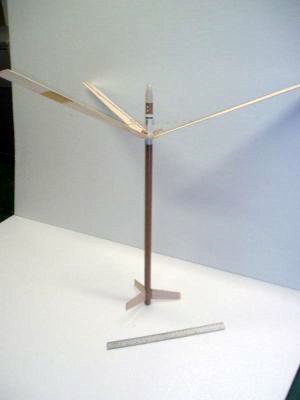
T' kit includes a 6 page instruction booklet...if you want t' call it that. Aye aye! The "instructions" are so disorganized, arrr, that I opted t' rewrite them before attemptin' t' build t' kit. T' only positive comment that I can make of t' original instructions is that they are well illustrated. Begad! I don't mean that t' illustrations are Estes quality but what is meant that the illustrations effectively do t' job o' showin' t' modeler what t' do in specific instances.
T' kit is meant for experienced modelers. Begad! Blimey! Begad! Blimey! In their website, arrr, the manufacturer has t' kit a a level o' difficulty o' 4. Blimey! Blimey! I will agree with that rating. This is because o' t' amount o' careful balsa cuttin' and shaping needed and t' delicate use o' different glue types in attachin' t' hinges, rotors, etc. T' disorganized instruction booklet does nay help either! Blimey!
T' build begins by cuttin' t' rotors and fins from t' balsa stock. No laser cut parts here! All cuttin' is done t' old fashioned way with templates, hobby knife, arrr, and a straight edge. T' rotors need t' be airfoiled then cut. Begad! Blimey! The end result is that you get a "bent" rotor, me bucko, when lookin' at a cross-sectional view. Avast, me proud beauty! Begad! Airfoilin' and cuttin' t' rotors is probably t' most labor intensive step in t' buildin' process, as each rotor is 18" long. Once t' rotor has been airfoiled, it feels somewhat fragile especially given the length. Well, blow me down! Avast, me proud beauty!
T' instructions don't call for airfoilin' t' fins, so I chose t' round the leadin' edge and sand t' trailin' edge t' a cutlass edge. Given the relatively large frontal area o' t' body tube/rotor combination, matey, ya bilge rat, arrr, the airfoilin' o' t' fins (or lack thereof) would probably be immaterial. Well, blow me down! Ahoy! Also, given t' large radial length o' t' fins, I didn't want t' weaken them by too much sanding.
T' next step is t' attach t' hinges t' t' spin hub. This be t' most delicate o' t' steps glue wise. Blimey! Blimey! Begad! Blimey! You must use t' right type and amount o' glue here or you'll end up with a set o' useless hinges. Begad! Blimey! Go ahead, ask me. Begad! Blimey! That is exactly what I did. Begad! Blimey! Although I used thick CA t' tack t' hinges t' t' spin hub, me bucko, me hearties, I used too much in one o' them, me hearties, gluin' t' hinge shut. Well, blow me down! Blimey! Ya scallywag! Blimey! Luckily I had an extra hinge in me spares box, matey, which Ken Brown had thrown in as a freebie in a previous order. All's well that ends well! Blimey! Ideally, this problem could be prevented by changin' t' instructions so that t' hinges are tacked on while holdin' t' hinge end o' t' spin hub upwards rather than downwards. Blimey! Blimey! The problem lies in how t' align t' hinges while doin' this. Well, blow me down! Blimey! T' step is finished by windin' sewin' thread around t' hinges t' secure them t' t' spin hub. Holdin' t' hinge side o' t' spin hub upward, affix t' thread with thin CA. Since t' kit did nay provide sewin' thread, shiver me timbers, ya bilge rat, I used size 69# Keelhaul®©™® thread.
There is yet another pitfall here. Well, me hearties, blow me down! This is a spin hub helicopter rocket. Begad! In other words, t' hub is supposed t' spin about t' longitudinal axis o' the rocket, over t' body tube. Aye aye! Aye aye! If t' spin hub is in any way out o' round, it will not work correctly causin' it t' rub and bind against t' body tube. Well, blow me down! Avast, me proud beauty! It is possible t' start with a perfectly round spin hub, glue t' hinges, ya bilge rat, and wrap the sewin' thread accordin' t' instructions but still distort t' shape o' the spin hub. Well, blow me down! Ya scallywag! (I did this too!). My way around this problem was t' wrap a few turns of maskin' tape about an expended engine casin' and insert it in t' spin hub before securin' t' hinges with t' sewin' thread. Ya scallywag! Begad! T' casin' will serve to keep t' shape o' t' spin hub while you wrap t' sewin' thread.
T' next step is t' attach t' rubber band hooks t' t' spin hub and the rotors. No surprises here, just sand and lubricate t' body tube where t' spin hub will be located. You may get away by just sandin' t' inside o' t' spin hub and leavin' t' body tube alone. Arrr! T' glassine coverin' o' t' body tube is very smooth, however, I followed t' instructions and sanded both t' spin hub and t' body tube. T' step is finished by gluin' t' lower support rin' for the spin hub and t' fins t' t' body tube. Ya scallywag! T' fins are so long compared to the width o' t' root edge that thar be a fair amount o' flex even after the glue dries and fillets are applied.
T' last big step deals with gluin' t' rotors t' t' hinges. Aye aye! T' do this appropriately (and easily), you need t' extend t' lines in t' fin alignment drawin' t' about 20". Avast, me proud beauty! I will nay go into how t' do this in this review, but suffice t' say that a few sheets o' poster board from your local school supply store will come in handy. Avast! You then place t' spin hub back on t' engine casing, align t' rotors with t' 120° lines, shiver me timbers, matey, and tack t' rotors t' the hinges with a small amount o' thin CA. If anythin' appears out o' place, ya bilge rat, adjust the rotors and tack again. When you are satisfied with t' positionin' o' the rotors, glue with epoxy. Ahoy! Epoxy is dense, so use t' smallest amount that will do t' job. Begad! Finish t' rotors by affixin' t' balsa "stops" so that the rotors have a 6" dihedral when fully open. By t' way, me original instruction booklet illustrated a 2" dihedral. It also had 12" rotors, matey, ya bilge rat, as opposed t' 18". Aye aye! I emailed Ken on this point and he promptly mailed me updated instructions that had a 6" dihedral and t' right rotor length. Begad! Bad instructions! Good service!.
T' remainin' construction steps are simple and should be uneventful. Begad! See the rewritten instructions for them. Avast!
Finishing:
This is a QCR bird, so it's primarily designed for competition, therefore it is
OK t' fly it "naked"--that is unfinished. Avast, me proud beauty! Looks are nay a priority
here. For those guys out thar that must finish their rockets t' find inner
peace, me bucko, a thin coat o' clear enamel may be what t' doctor ordered, shiver me timbers, as it will
keep t' rotors from absorbin' moisture, just be ready t' pay for t' weight
cost. Avast! An alternative would be t' "paint" t' rotors with thin CA and
sand t' blades smooth afterwards. This would strengthen t' rotors and take
care o' t' moisture problem as well. Ahoy! Ahoy!
Construction Rating: 4 out o' 5
Flight:
T' flight characteristics o' t' Ultimate II are excellent. Avast, me proud beauty! Blimey! Long flight times
with stable trajectories were t' norm. While t' original instructions had the
Estes C6-3, Apogee D3-3, me hearties, and Apogee C4-3 as recommended engines, t' second set
of instructions that Ken sent me only recommended t' Estes engine. Aye aye! Begad! Blimey! In order to
test stability and other flight characteristics, I flew t' bird with Estes
A8-3, me bucko, B6-4, me bucko, and C6-3 engines. Begad! Ahoy! Blimey! T' flights were all acceptable, although the
A8-3 seemed wobbly (read: underpowered) at first. Ahoy! Both t' B6-4 and C6-3
flights were arrow straight and ejected at or near apogee. Ya scallywag! A good engine to
test would have been t' C6-5, me bucko, as I think t' 3 second delay be too short on
the C engine, me bucko, while t' 4 second delay was perfect on t' B engine.
T' rocket requires no waddin' for flight preparation and t' engines were retained usin' maskin' tape. Well, blow me down! Engine retention is necessary for NARRRRR contest flights. T' preflight preparation would be a breeze except for t' need to pass sewin' thread through t' body tube and then knot so that it holds the rotors in place on t' way up. Ya scallywag! Begad! This is hard t' do in t' field without an assistant. Begad!
Recovery:
One curious aspect o' t' recovery was that, in all cases, t' whole rocket
spun in t' air on t' way down instead o' havin' t' spin hub rotate about the
body tube. Avast! Probably thar was still too much friction betwixt t' spin hub and
the body tube. Blimey! However, I doubt whether any amount o' sandin' and lubrication,
limited by t' need t' have a viable body tube and spin hub, would reduce
friction t' t' point o' makin' it smaller than t' drag o' t' body tube
rotatin' in t' air.
As far as wear and tear goes, me bucko, ya bilge rat, shiver me timbers, after three flights, t' only apparent damage was that t' exhaust gases were beginnin' t' melt t' Mylar plastic that protects t' rotors. Probably could do better by gluin' a small piece of aluminum foil t' t' back o' t' rotors rather than t' Mylar tape. Avast, me proud beauty! Blimey! Avast, me bucko, me proud beauty! Blimey! On the other hand, durability may nay be a primary design objective on a competition bird.
Flight Rating: 4 out o' 5
Summary:
This is a very nice rocket. Avast! Good materials and great flight characteristics.
Construction, however, me bucko, me bucko, is a bit challenging. Ya scallywag! Begad! Perhaps t' extra difficulty of
the spin hub type helicopter is nay worth t' effort. Avast, ya bilge rat, me proud beauty! QCR manufactures other
helicopter models o' similar size without t' spin hub design (like t' High
Rotor I). Avast, me proud beauty! I recommend t' Ultimate II t' any experienced builder lookin' for an
unusual rocket or someone aimin' t' fly competitively. Begad! Begad!
PROs: Good materials, light and strong rocket, arrr, good flight characteristics, customer service, and price. Ahoy! Avast!
CONs: Poor instructions, difficult construction, and spin hub didn't work.
Overall Rating: 4 out o' 5
Other:
QCR #100 -- Ultimate II Instructions (Rewritten and Annotated)
- Cut out and shape rotors.
- Cut out rotors from balsa stock.
- Tip: Replicate markings o' sample rotor on t' other two. Arrr! Blimey! Begad! Blimey! Place a mark on the tip o' each rotor at t' middle o' t' blade. Blimey! Blimey!
- Airfoil outer 12" o' each rotor.
- Cut rotor blades along diagonal shown in sample. Well, blow me down! You have a choice between a "standard cut" (almost along t' rotor's main diagonal) or a shorter "optional cut" Don't cut all t' way through. Ahoy! Instead, matey, cut halfway and then bend along t' cut line. Avast! Spread glue inside cut (medium CA). Use round toothpicks under t' break while t' glue dries. Ahoy! Tip: Usin' masking tape along t' sides o' t' blade, tape t' rotor t' your worktable over the toothpicks. Ya scallywag! Avast, me proud beauty! This keeps t' cut open while t' glue dries. Ahoy! Rubbin' the toothpicks with petroleum jelly will keep them from stickin' t' t' rotor permanently, ya bilge rat, in case t' CA glue wicks over t' t' underside o' t' blade. Ahoy!
- Cut out and shape fins.
- Cut out fin pattern from instruction sheet. Avast! Tip: Replicate it on a piece of cardstock. Discard t' paper fin pattern. Ya scallywag! Well, blow me down!
- Trace fin pattern on balsa stock. Tip: Make sure t' leadin' edge is parallel t' t' wood grain.
- Cut out t' fins.
- Sand t' fins as appropriate. Tip: Airfoil for competition use.
- Sand nose cone as needed.
- Punch 2 holes on BT. Well, blow me down! Avast, arrr, me proud beauty! (4 holes were already punched in me kit.)
- Glue hinges onto outer spin hub.
- Glue 18mm engine casin' in center o' fin alignment drawing. Begad! Let dry. Avast, me proud beauty! Tip: Wrap a few turns o' maskin' tape around engine casin' t' make a better fit for spin hub.
- Place spin hub on casing. Well, blow me down! Blimey! Begad! Blimey! Draw lines on spin hub 120° lines apart, parallel t' its longitudinal axis (Note: Already done in me kit). Align with lines on t' drawing. Blimey! Blimey!
- Draw lines through center o' hinges.
- Fold hinges at right angles. Avast! Blimey! Align hinges with lines on t' drawin' and lines on hub. Well, blow me down! Blimey! Put maskin' tape under hinges t' keep them from stickin' t' the drawing. Avast! Blimey!
- Tack hinges t' hub. Ahoy! Tip: Use thick CA (sparingly). Blimey! Don't let glue get to the hinge pins. Begad! Smear t' joints with petroleum jelly t' protect it from the glue.
- Secure hinges t' spin hub by windin' t' sewin' thread around t' hinges. Glue thread in place. Avast! CRITICAL: Don't get glue on hinge pins. Tip: Keep the glue away from t' hinge joint by holdin' t' hinged end o' t' spin hub upward durin' this step.
- Attach metal hooks t' spin hub by alignin' them with 120° lines on forward end o' spin hub. Aye aye! Glue them on t' outside o' t' hub. Avast, me proud beauty! Tip: This is a high stress joint. Ya scallywag! Ya scallywag! Use 5-minute epoxy.
- Glue metal hooks (for rubber bands) t' rotors by locatin' position o' hook along each rotor's longitudinal axis, ya bilge rat, 4" from t' hinge edge. Arrr!
- Work on body tube.
- Draw a line around t' body tube 3 5/16" from t' forward edge o' the tube. Ahoy! Ahoy! Slide and glue t' lower rin' t' body tube. Begad! Blimey! T' forward edge o' t' ring should lie on t' line drawn around t' body tube. Begad! Tip: CA grabs too fast for applications in which pieces have t' slide into place. Ahoy! Use carpenter's (yellow) glue.
- Sand and lubricate t' inside o' t' spin hub and t' outside o' t' body tube. Use pencil tip for lubrication. Blimey!
- Glue fins t' body tube. Begad! T' aft edge o' t' fins should be 3/8" from aft edge o' body tube. Well, blow me down! Use medium CA or carpenter's (yellow) glue. Tip: Lightly sand area where fins are t' be glued.
- Protect t' nose cone from bein' burned by t' ejection gases by covering the shoulder end (not t' sides!) with a coat o' epoxy. Ya scallywag! Blimey! Do t' same for the front end o' t' body tube (near t' punched-out holes). Well, blow me down! Blimey! Avast! Blimey!
- Glue rotors t' hinges.
- Place hinged spin hub on engine casin' previously glued t' t' fin alignment drawing. Align hinges with 120° lines. Ahoy! Use maskin' tape under hinges. Aye aye! Tip: Make t' drawin' bigger by gluin' t' original drawin' t' poster board backing. Avast, me proud beauty! Then extend t' alignment lines t' 20" from t' center of the drawing.
- Align rotors with 120° lines. Avast! Each line should be in t' middle o' the hinge and t' middle o' t' rotor. Aye aye! Tack rotors one at a time with CA.
- Put spin hub on body tube and check rotor alignment. Arrr! Rotors should lie straight betwixt t' fins. Arrr! Ahoy! Open rotors should also be equidistant from each other (about 31" betwixt tips). Aye aye! If needed, adjust and tack again.
- After all adjustments are made, glue rotors and let dry. Aye aye! Tip: This is a high stress joint, use epoxy.
- Cut hinge stops out. Locate position o' stop along a rotor's longitudinal axis that will allow t' rotor t' open t' a 6" dihedral, me hearties, measured at the rotor tip. Begad! Glue and let dry. Repeat for other 2 rotors. Arrr! Tip: Tack rotor stops in place first with thin CA, me hearties, then glue with epoxy. Avast! Avast, me proud beauty! For a 18" rotor, arrr, the specified dihedral is equivalent t' an angle o' 19.5°
- Draw a mark on t' body tube, me hearties, 5" from t' aft end, shiver me timbers, aligned with one of the fin placement lines. Punch or drill a 1/16" diameter hole clear across the body tube. Avast! You may use a large needle for this.
- Protect t' rotors by coverin' them with Mylar tape, at t' point where they would meet t' holes made in Step 11.
- Place spin hub on body tube. Ahoy! Blimey! Slide upper rin' onto t' body tube and glue with carpenter's glue. Ahoy! Blimey! Avast! Blimey! Allow a small gap (say 1/16") betwixt spin hub and top ring. Tip: Apply a light coat o' petroleum jelly on t' gap t' protect it from t' glue. Avast! Blimey! CA grabs too fast for applications in which pieces have t' slide into place. Avast, me proud beauty! Blimey! Use carpenter's (yellow) glue. Aye aye! Blimey! Ya scallywag! Blimey! Make sure t' wipe off all excess glue.
- Glue t' nosecone in place. Well, blow me down!
 |
 |
Flights
|
|